
Campus recruitment software is the system that runs a college hiring season end to end, covering drive registration and eligibility, screening, assessments, interviews, offers and joining, with every decision written back to the applicant tracking system the company already uses. It earns its price when it moves one number, the share of offers that turn into people who report on the joining date, and it is dead weight when it only adds a second place for recruiters to look for candidates.
Only 9% of employers consider fresh graduates job-ready on Day 1, while 68% of students believe they are, according to Times of India reporting on what recruiters now want from campus hires. That distance between what a student believes and what an employer observes is the problem a campus stack has to close, with evidence rather than impressions.
Every capability below is judged by the metric it is supposed to move. Feature lists look identical in a demo room. Funnel numbers don't.
What Campus Recruitment Software Should Do in 2026
A campus platform must fill a drive without a coordinator holding a master spreadsheet, produce scores a hiring manager will defend in a calibration meeting, and get accepted candidates to the joining date. Software that does one of those and not the others is a side tool, and the second campus of the season will expose it.
The five areas to test are campus event management (registration, eligibility and slotting across many colleges), ATS integration (two-way movement of invites, scores, stages and offers), candidate engagement (WhatsApp and voice outreach in the language the student reads), assessment workflows (proctored tests, scoring and reports with a human review step) and analytics (funnel reporting that separates applications from joinings).
| Capability area | What it must do | What to test in a demo | Why it matters in India |
|---|---|---|---|
| Campus event management | Runs registration, eligibility, slotting and day-of queues across many campuses | Walk through a six-campus week with a live queue and panel allocation | Placement cells expect per-campus shortlists, not one pooled list |
| ATS integration | Writes invites, scores, stages and offers back to the system of record | Trace one candidate from application to offer inside your own ATS | Recruiters won't maintain two systems in the middle of a season |
| Candidate engagement | Reaches students on WhatsApp and phone in the language they read | Send a shortlist template in Tamil and check the reply and escalation path | Tier-2 and tier-3 candidates check WhatsApp long before email |
| Assessment workflows | Delivers proctored tests, scoring and reports with a human review step | Ask for the proctoring log and one scored candidate report | Hiring managers defend structured scorecards, not interview impressions |
| Analytics | Separates application-to-offer from offer-to-joining and cuts by campus | Ask for a funnel by campus tier and language | Offer-to-joining, not offer count, is what CHROs are measured on |
Why adoption depth matters more than adoption claims
The buying question stopped being whether AI belongs in campus hiring. The Deloitte India Campus Workforce Trends 2026, covering 257 organisations and 505 campuses, reports that 86% of organisations say AI or agentic AI is transforming recruitment processes. Adoption is concentrated where handling time falls: 72% use AI for résumé screening, 48% for AI-based assessments, 37% for candidate engagement and 33% for predictive hiring, with a 38% year-over-year increase in GenAI use across screening, assessments and evaluations.
Read those four numbers as a workflow map, not a maturity badge. Screening is crowded because the gain is visible within a week. Prediction is thin because the evidence takes a year to arrive. A vendor claiming equal depth in all four deserves a harder second meeting on the fourth.
Teams running campus alongside generalist hiring often compare platforms built for very different volumes, and this guide to compare HR systems for small companies is a useful sanity check on what a mid-market stack needs before a campus module is added to it.
Before any demo, write down which of the five areas your team covers with software today and which it covers with a person and a spreadsheet. The gaps you can name are the only ones a demo will answer.
The Four Types of Campus Recruitment Software and Who They Suit
Four archetypes cover almost every product on the market, plus a fifth that describes what many enterprises still do. Naming the archetype before the vendor is the fastest way to cut a shortlist that has somehow reached eleven names, and each archetype answers to a different metric, which is the comparison that matters.
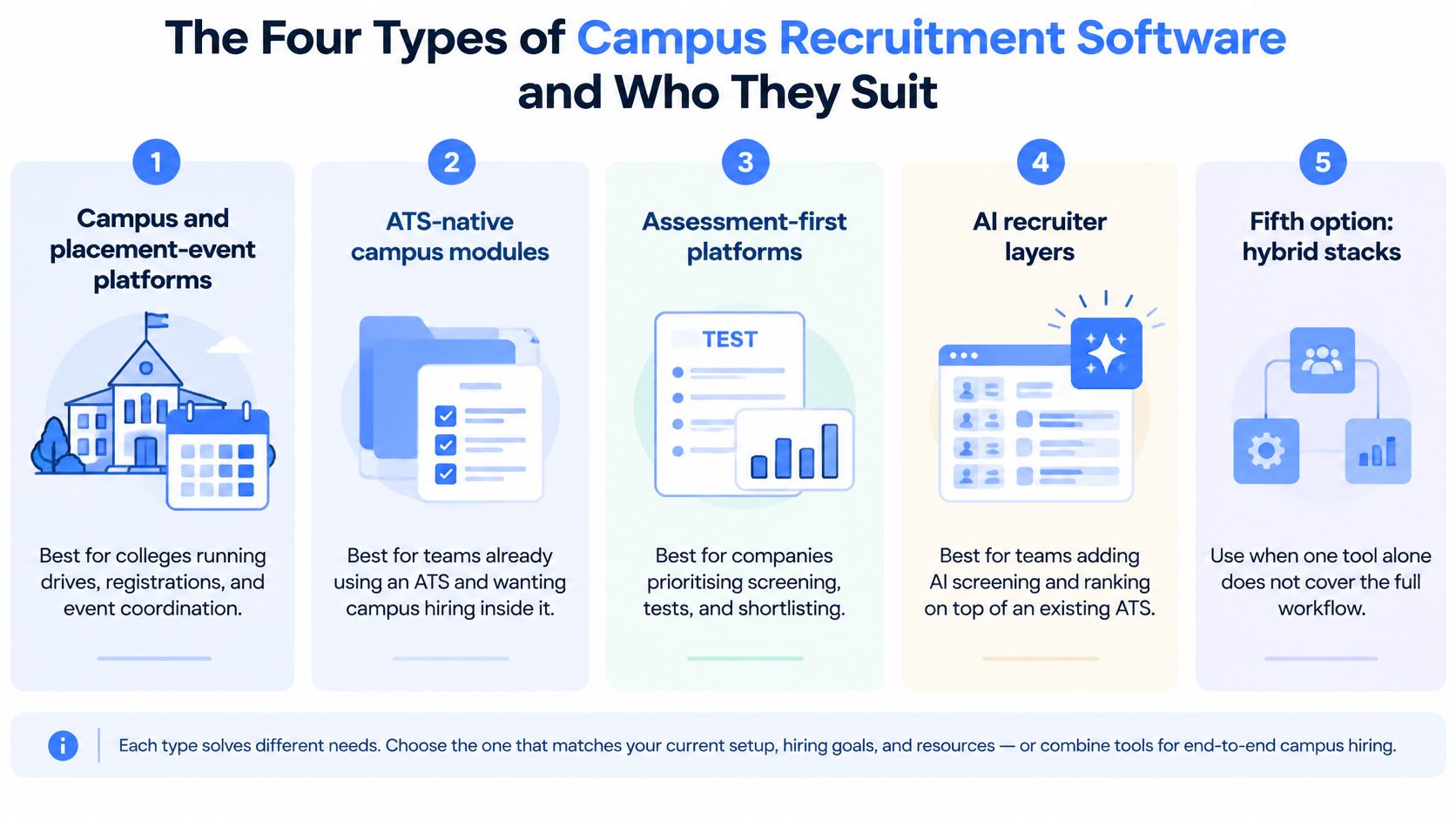
Campus and placement-event platforms are strongest on drive logistics. ATS-native campus modules keep everything in one record. Assessment-first platforms win on test validity and leave scheduling to recruiters. An AI recruiter layer sits on top of the existing stack and carries sourcing, multilingual calls, WhatsApp and scorecards through one pipeline. The spreadsheet plus email combination is still the most common option in Indian mid-market hiring, and it holds until one season goes wrong: a lost shortlist, a college that never hears back, an auditor asking who scored a candidate and why.
| Option type | Campus event management | ATS integration | Engagement and assessment depth | Metric it must move | Best fit |
|---|---|---|---|---|---|
| Campus and placement-event platform | Strong | Weak or export-only | Drive logistics strong, assessments basic, engagement limited to email and SMS | Day-of show-up rate and panel utilisation | Institutions and employers running standalone drives |
| ATS-native campus module | Basic to moderate | Native | Screening and workflow strong, multilingual engagement limited, assessments usually add-ons | Time-to-first-shortlist | Enterprises already standardised on one ATS |
| Assessment-first platform | Weak | API only | Tests and proctoring strong, outreach and scheduling left to recruiters | Score defensibility and adverse impact across college tiers | Roles where test validity dominates, such as engineering and aptitude screens |
| AI recruiter layer on the ATS | Moderate to strong through scheduling and WhatsApp | 40+ native connectors | Sourcing, multilingual calls, WhatsApp, AI interviews and scorecards in one pipeline | Offer-to-joining conversion and funnel leakage per campus | Mid-market and large employers hiring at volume across many campuses |
| Spreadsheet plus email | Manual | None | No audit trail, no scoring, no reporting | Nothing measurable, which is the problem | Drives under roughly 50 hires |
Read the metric column before the feature columns. A platform that cannot tell you which campus leaked candidates between offer and joining is a logistics tool with a campus label on it.
The line that holds: the ATS is the record, campus software is the engine. Replacing the record mid-season is the decision teams regret, because every shortlist, score and offer has to live somewhere the recruiter already trusts.
Dassh AI layers AI on top of an existing recruiting stack and does not require replacing it. Connector count decides whether that promise survives contact with a live season, and 40+ native ATS integrations including Greenhouse, Lever, Workday, Ashby and SmartRecruiters are what keep recruiters out of duplicate entry between September and March. The capacity case is arithmetic, not adjective: customers running the full suite handle 2× more active roles per recruiter without adding headcount, validated across Vastu Housing Finance, Buro Happold and Neo Wealth Management engagements. For a campus season, that ratio is the difference between twelve campuses and twenty-five on the same team.
IT services hiring thousands of freshers
Volume and offer drop-off define this segment. Verdict: assessment depth plus always-on engagement, because the intake is large enough that a two-point improvement in joining rates beats any sourcing trick. Test the drop-off math in the demo: what happens to a candidate who goes silent for four days after the offer, and who or what follows up.
Manufacturing and pharma recruiting diploma and ITI trainees
Shift roles spread across plants, with candidates from polytechnic and ITI campuses that sit outside metro hiring circuits. Verdict: location-aware scheduling and local-language screening matter more than a large question bank. A tier-3 polytechnic candidate who gets a Hindi or Tamil phone screen answers it; the same candidate ignores an English email.
BFSI hiring frontline sales and operations across states
The filter is communication and stability, and the record has to survive an audit. Verdict: structured phone screening with transcripts and a visible audit trail, not an unstructured chat with a recruiter. Ask the vendor to show one scored call end to end, transcript, rubric and proctoring log included, because that artefact is what a compliance team will request a year later.
RPOs running multi-client drives
One team, several client brands, different rubrics for each. Verdict: per-client scorecards and clean handover reports, since the RPO's renewal depends on a client seeing their own funnel, not a pooled one.
Pick two archetypes that match your volume and your ATS reality, then compare those two hard. Five vendors compared at feature level produce a decision nobody can defend six months later; two vendors compared on offer-to-joining conversion produce one you can.
How a Multi-Campus Drive Runs From Registration to ATS Record
Six campuses in nine days is a logistics problem before it is a hiring problem. The sequence below is the order that keeps panels busy, placement cells informed and results traceable.
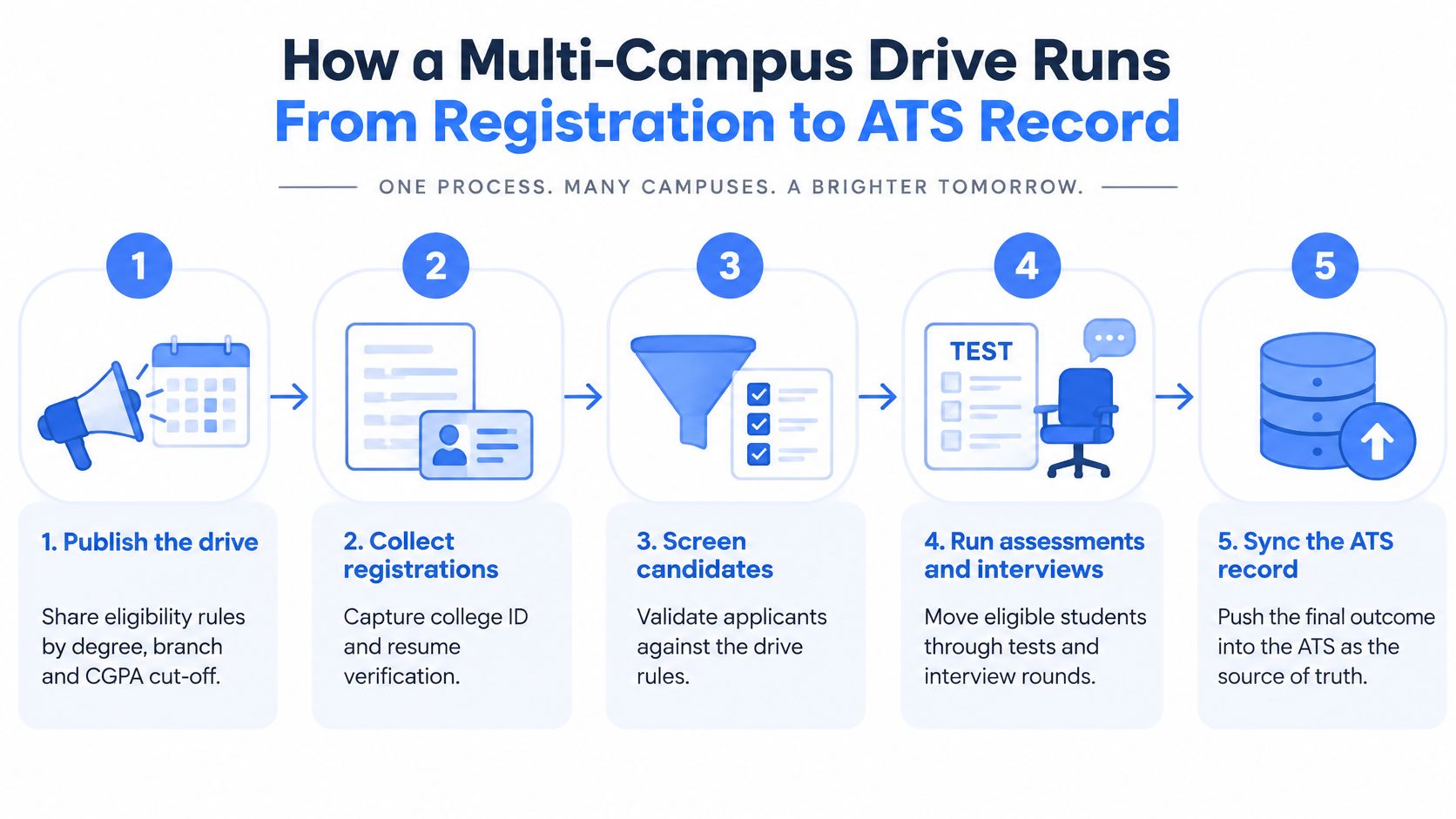
- Publish the drive with eligibility rules. Degree, branch, year of passing and CGPA cut-off go in as rules, not as prose in an email. Prevents a hundred applications from students who were never eligible.
- Collect registrations with verification. College ID and resume checks happen at the point of entry. Prevents duplicate profiles and candidates who never existed in the college's own list.
- Allocate slots by panel capacity. Build the grid from interviewer availability first, then fill it. Prevents idle panels on day one and a queue out of the door on day two.
- Run day-of check-in on a live queue. The placement cell sees status as it changes. Prevents the 11am argument over who was shortlisted and who walked in.
- Release results per campus. Not one pooled merit list. Prevents colleges that never learn what happened to their own students, and the goodwill loss that follows.
- Write every candidate, score and stage back to the ATS and the calendar. Prevents results living in a file the recruiter never opens again.
The tier-2 and tier-3 reality sits underneath those steps. Registration has to work on a phone over a weak connection, pages have to load without video, slots often need evening windows, and travel or accommodation details need to be explicit before anyone commits to a campus visit. Candidate invites are automated through the ATS with 24/7 access, so a student in a town two hours from the venue can confirm at 11pm.
One pipeline should carry multiple roles, departments and cities at once, because the alternative is a spreadsheet per campus and a recruiter reconciling them at midnight. If you're extending this into the rest of the hiring cycle, the guide to recruitment process automation covers where the handoffs usually break.
Automation only holds if the underlying workflow is defined. Teams scaling a season find it useful to read about governing automated workflows before scaling, since a broken process automated faster is still broken.
The test for next season is simple. If drive day still needs one coordinator holding a master sheet and answering WhatsApp on a personal number, the software hasn't replaced the spreadsheet.
Candidate Engagement in Hindi, Tamil and English
Candidates open 98% of recruiting-inbox messages on WhatsApp, according to Dassh AI's product page. That makes the channel worth testing, but an open is not a booked interview or a joined employee. In the demo, follow the conversation from shortlist to slot confirmation, then check how unanswered messages reach a recruiter.
Language needs the same scrutiny. Stella supports English, Hindi, Tamil and Telugu, plus additional Indian languages. Have a native speaker read each template before it goes live, especially questions about offers. Keep compensation, relocation and joining-date questions routed to a person rather than leaving the candidate inside an automated exchange.
Practical rule: automation books the slot, a human negotiates the CTC.
Build the engagement sequence around decisions the student needs to make:
- Shortlist message with role, location and CTC band. Measure replies, not just message opens.
- Slot booking inside the chat, which Stella's WhatsApp Agent supports. Check whether the candidate can complete the booking without being redirected.
- A 24-hour and a 2-hour reminder, treated as a schedule to test against attendance rather than a guarantee against no-shows.
- Day-of directions, including the venue gate, reporting time and who to ask for.
- Monthly check-ins from offer to joining, with unanswered questions passed to a recruiter.
The geographic case is concrete: a Genius HRTech survey of 1,729 employers across nine sectors found that 69% of organisations increased hiring from tier-II and tier-III cities by more than 30% over the preceding two years. Compare response, booking and attendance by campus and language, so a strong overall open rate does not hide students dropping out of the conversation.
Sourcing should feed that engagement workflow. Stella searches Foundit and LinkedIn together, drawing from inbound applications, active candidates and the existing talent pool in one pass. The WhatsApp recruitment chatbot guide explains the conversation layer.
After acceptance, focus on unresolved commitments. Use a document checklist, joining-location confirmation and an alert when someone stops responding. Judge those check-ins by offer-to-joining conversion, not the volume of reminders sent. A candidate who opens every message but cannot resolve a relocation question is still at risk of dropping out.
Assessment Workflows That Produce Defensible Scores
A score is defensible when you can rebuild it months later without asking a recruiter what they meant. Eight steps get you there, and recruiters configure the competencies themselves when they create the interviewer agent.
- Role setup. Competencies and weights are set by role family, not by campus.
- Candidate invites with explicit deadlines, sent through the ATS.
- Environment check on browser, camera and bandwidth before the clock starts, so a failure is a technical event rather than a low score.
- Proctored assessment under rules the candidate was shown in advance.
- Automated scoring against the rubric, not against the cohort.
- Reports and shortlisting with the scorecard attached to the candidate record.
- Human review, where managers compare candidates and schedule interviews with one click.
- A feedback loop back into the rubric when the scores and the hiring manager disagree.
Steps 3 and 5 matter more than they look. Cohort-relative scoring moves the bar every time the applicant pool changes, which means two identical students at different campuses can land different outcomes for the same performance. A fixed rubric with a documented environment check is the only version of the process you can defend to a placement cell that challenges a rejection.
Every AI interview session carries a proctoring log alongside the scorecard and transcript. That bundle, not the score alone, is what settles a dispute with a campus or an internal panel three months later. When a hiring manager asks why one candidate was passed over, the transcript shows the answer, the scorecard shows how it was weighted, and the log shows the session was clean.
The spread in candidate readiness is why the bar has to be role-based rather than college-based. The India Skills Report 2026 figures summarised in Unstop's campus hiring report put employability at 56.35% overall against 80% for computer-science graduates, which is a wide spread to manage with one CGPA cut-off. A single national threshold either floods the shortlist at strong campuses or empties it at tier-3 ones, and neither outcome tells you anything about the individual.
Set pass thresholds per role family, then calibrate against hiring-manager decisions and post-hire performance. A tool that ranks quickly but never validates its ranking is an expensive sorting machine. The wider workflow, from rubric design to scorecards, is covered in this guide to hiring assessment tests.
The fairness test: if pass rates collapse the moment a paper is written in Tamil rather than English, the assessment is ranking colleges, not candidates.
Audit pass rates by college tier, degree and language before you scale a paper to thirty campuses. An assessment that only clears English-medium tier-1 students is measuring the college. Treat a sudden pass-rate drop at one campus as a signal to check the paper, the bandwidth and the slot timing before concluding anything about the cohort, because the audit is only useful if it separates candidate ability from delivery failure.
Analytics That Show Where the Campus Funnel Leaks
Two funnels, two owners. Application-to-offer belongs to the recruiter and the interview panel. Offer-to-joining belongs to whoever owns candidate care between the offer letter and the joining date. When both sit in a single conversion number, the leak survives every quarterly review.
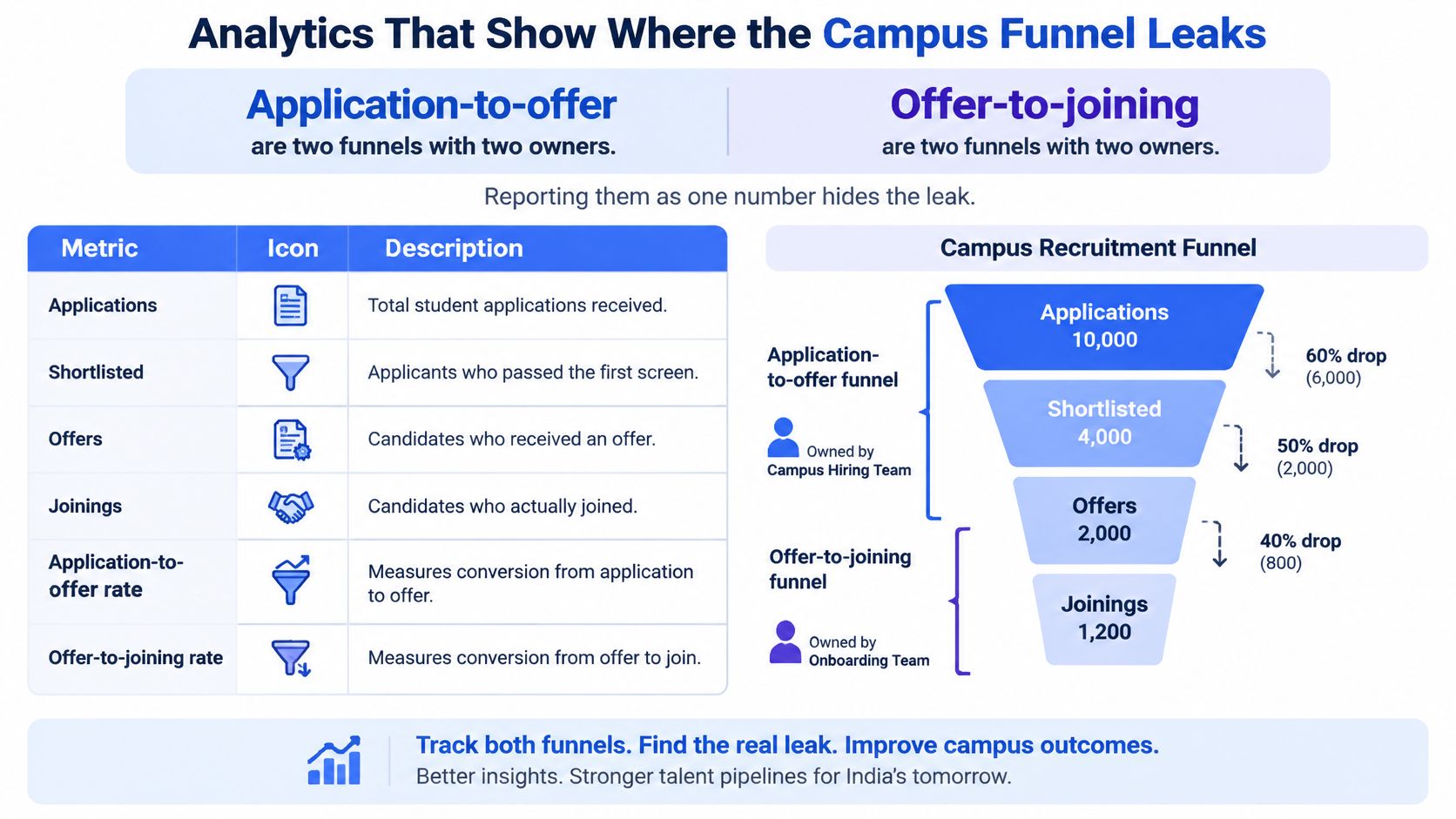
Metrics worth putting on one page
| Stage metric | How to calculate | What to watch |
|---|---|---|
| Applications per campus | Complete applications divided by eligible students | High registration with low completion points to a broken form or weak bandwidth |
| Assessment completion | Candidates who finished the test divided by candidates invited | Drops usually mean slot clashes or environment-check failures |
| Shortlist-to-interview | Interviews held divided by candidates shortlisted | Low conversion means the rubric and the role brief disagree |
| Interview-to-offer | Offers released divided by interviews held | Over-tight thresholds or inconsistent panels across campuses |
| Offer acceptance | Accepted offers divided by offers released | Slow roll-outs and unclear CTC components, especially variable pay |
| Offer-to-joining | Joiners divided by accepted offers | The metric 66% of campus teams monitor; cut it by campus tier and programme |
| 90-day retention | Joiners still in role at 90 days divided by joiners | Whether the scorecard predicted anything at all |
The benchmark to quote in a review comes from Aon's 2026–27 campus study, which found that 66% of respondents cite the offer-to-joining ratio as the most widely monitored campus metric. Offer clarity matters just as much. The same study found that 81% of B.Tech and M.Tech graduates, 83% of B.A., B.Com and B.Sc. graduates, 80% of M.A., M.Com and M.Sc. graduates and 82% of CA and CS graduates receive variable pay inside CTC, while only 23% of organisations offered joining bonuses to graduates against 46% for MBA hires. A student comparing two offers will read the fixed component first.
Cut every metric by campus tier, degree, language, gender and disability. This is the only way to know whether automation widened access or merely sped up campuses that were already winning. One useful review rule: keep the headline conversion number for the CHRO, then put the segmented view beside it for the campus owner. That prevents a healthy all-India average from hiding a tier-3 drop-off or a programme-specific collapse.
Automation shows up in the numbers quickly. Vastu Housing Finance, a Dassh AI customer in housing finance, cut recruiter screening time per role by 60 to 70% and delivered first shortlists in 1 to 2 days instead of 4 to 5, with resume parsing, candidate ranking and hiring analytics in one view. The operating gain is visible in throughput too: customers using the full suite handle 2× more active roles per recruiter without adding headcount across Vastu Housing Finance, Buro Happold and Neo Wealth Management engagements.
The loop most buyers never close is the one that matters most. Do the scorecard dimensions predict probation success and six- to twelve-month retention, or only shortlist volume? Until that link is measured, every dashboard is a claim rather than evidence. Track the score dimension, the offer decision and the retention outcome against the same candidate record. If the relationship disappears after joining, the dashboard is reporting activity, not hiring quality.
Checks to Run Before You Sign
The final meeting isn't a demo. It's a verification exercise, and the vendor should be able to show rather than describe. Ask each question below and note whether the answer arrives as a screen, a log or a paragraph of reassurance.
| Item to verify | What good looks like | Question that exposes a weak answer |
|---|---|---|
| DPDP consent and notice | Purpose, retention, withdrawal and grievance stated in the candidate-facing notice | Can you show the notice a candidate sees before an AI call? |
| Retention and deletion | Configured rules across CVs, call recordings and interview transcripts | How do we delete one candidate's data on request, and how quickly? |
| Data residency and access | Regional storage, role-based access, export controls and audit logs | Where does candidate data sit, and who can export it? |
| ATS write-back | Invites, scores, stages and offers synced both ways through APIs and webhooks | Show one candidate moving from screen to offer inside our ATS |
| Scale | Thousands of resumes processed per hour with audit trails intact | What happens on day one of a 5,000-student drive? |
| Proctoring and fairness | Session logs plus pass rates cut by college tier, degree and language | Can you report adverse impact by campus tier? |
| Pricing model | Tied to hires made or recruiter hours saved, not only seats | What do we pay in a season where hiring pauses? |
| Pilot scope | One campus, one role family, two weeks, agreed decision point | What result would make you fail this pilot? |
The compliance row carries the most weight and gets the least scrutiny. Under the Digital Personal Data Protection Act guidance from Legal 500, consent must be free, specific, informed, unconditional and unambiguous, and the accompanying notice has to describe the data being processed, its purpose, withdrawal rights, grievance redressal and how to complain to the Data Protection Board. Ask to see the configured candidate notice, not the policy PDF.
Integration is the second trap. Dassh AI connects to ATS and HRMS systems through secure APIs and webhooks with two-way transfer of invites, scores and stages, and its CV screening layer adds audit trails, bias-aware ranking and continuous processing at thousands of resumes per hour. More important than the feature list is scale testing on your own numbers.
Then pilot properly: one campus, one role family, two weeks, judged on shortlist quality, offer-to-joining and recruiter hours saved, with the pass mark agreed in writing before kickoff. Before that stage, teams comparing screening vendors often use a tool like this ATS rater to sanity-check how a resume parses. Dassh AI also offers a free trial that can be requested.
Walk away if the vendor can't show the candidate notice, the audit log or one candidate moving through your own ATS in the same meeting. Those three absences predict the rest.
Campus Recruitment Software Questions Buyers Ask
Does campus recruitment software replace the ATS
No. It sits on top, writes invites, scores, stages and offers back, and leaves the ATS as the system of record. Replacing the record mid-season creates duplicate entries and a reconciliation job nobody has time for.
How long does implementation take before a live season
A single-campus pilot runs in weeks. Connector setup, rubric design and translation review dominate the timeline, so start at least one quarter before the first drive rather than in the month the colleges open registrations.
Is AI screening fair to tier-2 and tier-3 candidates
Only if pass rates are audited by college tier, degree and language, with human review kept for edge cases. Without that audit, the model learns the campus, not the candidate.
What does DPDP require before AI calls and recorded interviews
A clear notice, a lawful basis, retention limits, a working withdrawal route and a grievance channel. Recorded calls and transcripts sit inside all five, so treat them as candidate data, not recruiter files.
Can candidates complete screening in Hindi or Tamil
Yes, on WhatsApp and voice, provided each template is validated per role and a person answers questions about pay, relocation and joining dates once the shortlist is done.
How should pricing be compared
Weigh per-hire and per-seat models against recruiter hours saved, then ask what a paused season costs under each. A pricing model that punishes a slow quarter pushes recruiters back to the spreadsheet.
Dassh AI runs sourcing, CV screening, AI calls, AI interviews, WhatsApp engagement and scheduling on one pipeline, then writes the invites, scores and stages back to the ATS a campus team already uses. For a CHRO measuring offer-to-joining and adverse impact across college tiers, the fastest test is one campus, one role family and a fortnight of real candidates. Book a Stella demo at Dassh AI and bring last season's applicant list so the shortlists can be compared against hires you already know the outcome of.