

A recruiter has a full campus shortlist, unfilled frontline roles and hiring managers asking for faster decisions. Hiring assessment tests measure job-relevant skills, reasoning and behaviour before an offer, and the right choice depends on the role and its level, not the trendiest tool. Entry-level and high-attrition hiring, such as field collections, retail sales or campus trainee pools, needs a cognitive check and a job simulation first. Managerial hiring needs a structured behavioural interview and a situational judgement test.
The mistake is giving every applicant the same assessment battery. A field collections executive, a pharma production supervisor and a financial analyst need different evidence, even when the organisation hires all three through the same ATS. Multilingual frontline pools add a second constraint: the test must measure the job skill rather than fluency in one language, and consent notices need to satisfy DPDP requirements before any response data is stored.
Match each role to the smallest useful assessment. Employers looking to Hire Financial Analysts should prioritise reconciliation, interpretation and explanation over an unrelated puzzle test. A campus pool needs reasoning and learnability evidence, while a supervisor hire needs judgement under realistic scenarios.
Start with one test, then add another only when it answers a different hiring question. Keep location, shift availability, notice period and compensation alignment separate from capability scores. A strong assessment result will not fix an unsuitable posting or prevent an offer drop-off caused by unclear employment terms.
1. When Should Recruiters Use a Cognitive Ability Test?
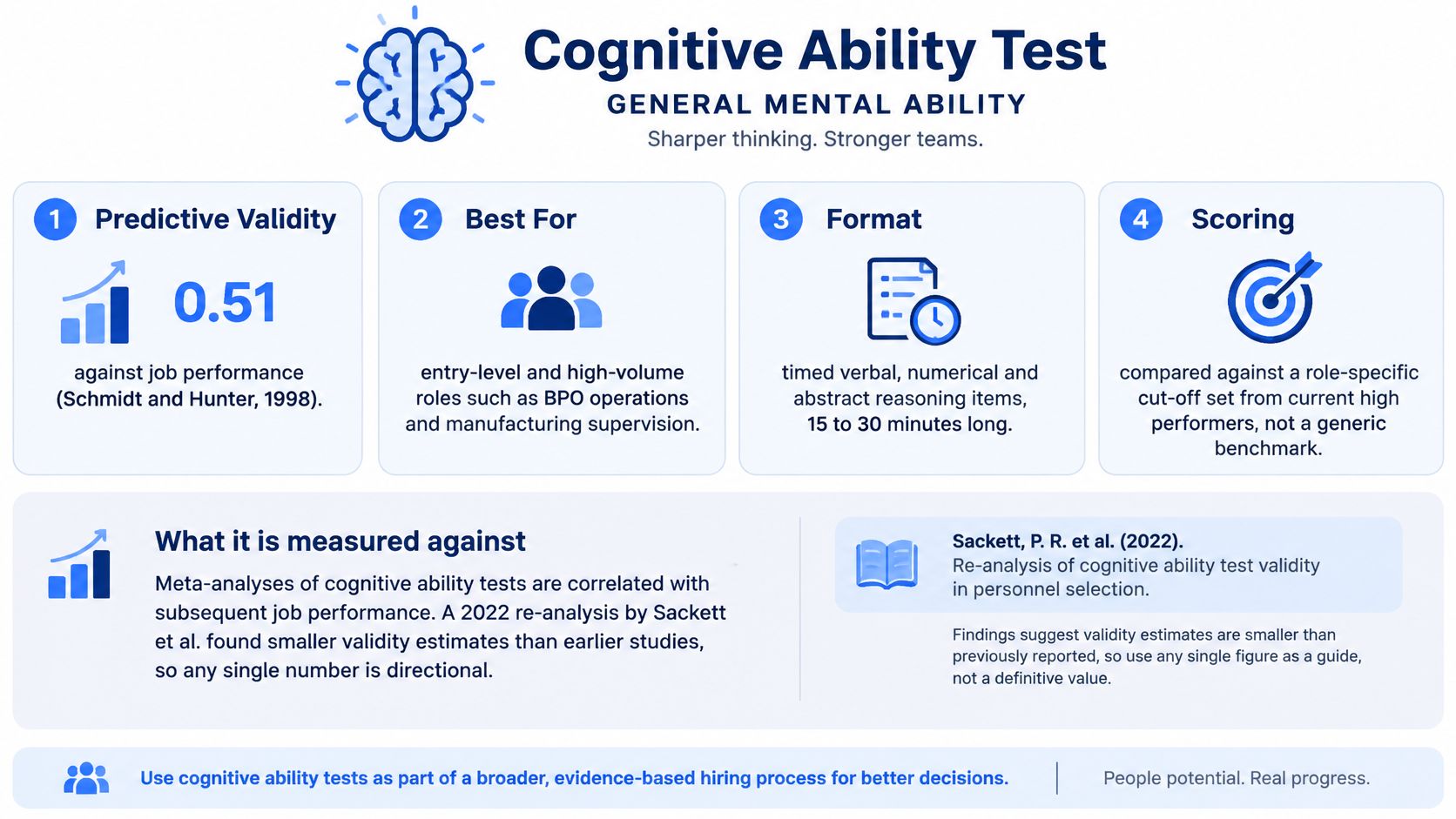
Few screens predict how fast a new hire will learn as reliably as a cognitive ability test. It measures how accurately a candidate reasons, learns and solves unfamiliar problems, typically through numerical reasoning, verbal comprehension, logical patterns and attention to detail.
That makes it the right first screen for campus pools and trainable frontline roles, where applicants arrive with little employment history to judge. In a multilingual applicant pool it can become an English examination instead, which measures the wrong thing entirely. Capture candidate consent under DPDP before any response data is collected.
A benchmarking exercise across Indian frontline-sales hiring found that logical reasoning and attention to detail scores separated high performers from the rest. That supports testing those capabilities in comparable field roles. It does not support copying the same benchmark into engineering or managerial hiring.
How Should the Cut-off Be Set?
Begin with representative tasks and ask current strong performers to complete them under the same conditions. Include a broader employee sample too, because testing only successful employees won't reveal how well the assessment distinguishes performance.
- Match the language: Offer equivalent-language versions where the job allows them, rather than translating questions informally.
- Separate speed from accuracy: A timed calculation test can penalise careful candidates when the actual role rewards error prevention.
- Check outcomes: Compare scores with training completion, work quality and supervisor ratings after joining.
For a warehouse trainee, a useful task is interpreting a stock movement sheet and identifying a mismatch. Abstract puzzles alone won't establish whether the candidate can follow an operating procedure.
Practical rule: Use cognitive scores to identify candidates worth investigating, not to make an unexplained final rejection.
The next time a hiring manager asks for an aptitude round, start with one reasoning task drawn from the job itself, then pair it with a work sample before adding anything else.
2. When Is a Situational Judgement Test the Better Choice?
A customer threatens to cancel after a delayed delivery. Does the candidate promise an unrealistic resolution, transfer responsibility, or establish the facts and explain the next step?
A situational judgement test, or SJT, presents a workplace scenario and asks candidates to select or explain an appropriate response. It measures practical judgement without requiring them to have held the exact job before.

This format suits customer service, retail, collections and supervisory hiring. In manufacturing or pharma, scenarios can examine escalation, documentation and responses to process deviations without putting applicants near live equipment.
The weakness is answer transparency. Candidates can often identify the polite response without understanding how to execute it, especially when the alternatives are obviously unreasonable.
How Can Recruiters Test Reasoning Rather Than Rehearsal?
Build scenarios with operational managers, not solely with HR. Ask managers to distinguish mandatory compliance actions from preferences about style.
- Describe a realistic incident, including the candidate's authority and available information.
- Ask which response is most appropriate and which would create the greatest risk.
- Probe the reasoning, then change a relevant constraint.
- Score the explanation against agreed behavioural anchors.
For a collections role, change the scenario after the initial response: the customer disputes the outstanding amount and asks for supporting records. The follow-up reveals whether the candidate understands verification and escalation rather than repeating a collection script.
Don't penalise missing company-specific knowledge that the employer hasn't supplied. If the correct answer depends on an internal policy, provide that policy within the assessment.
On Monday, ask frontline supervisors for recurring difficult decisions and convert those incidents into scenarios. Remove ambiguous items where experienced managers can't agree on what a defensible response looks like.
3. What Does a Job Simulation or Work Sample Reveal?
A collections agent picks up a mock call, reads a fictional customer record and has four minutes to resolve a payment dispute. That is a job simulation: a realistic slice of the work performed under assessment conditions. The work sample is the output, scored against a defined rubric. Other common formats include a reconciliation exercise, a sales conversation or a controlled equipment demonstration.
This is the right starting point when recruiters can observe the required capability directly. A candidate who explains a repayment discrepancy clearly provides more relevant evidence for a customer-facing role than one who merely recognises communication terminology. For frontline and high-volume requisitions, where a single opening can draw a very large applicant pool, a short scored exercise filters faster than credentials alone.
Keep the task representative, not exhaustive. Long unpaid assignments test availability and access to resources as much as capability. Never use applicants to complete commercially useful work disguised as an assessment.
What Should a Mock Call Measure?
For a BFSI service role, provide a fictional customer record and a standard objection. Assess whether the candidate establishes the issue, explains accurately, handles the objection respectfully and agrees a realistic next step.
Let the candidate respond in the language the job uses. A Hindi or regional-language call measures the skill the customer will hear, while an English-only prompt can screen out capable frontline talent for roles that never require it.
- Publish the criteria: Tell candidates what the exercise measures before it starts.
- Standardise the prompt: Give comparable information and preparation conditions to every applicant.
- Anchor the scoring: Describe observable behaviour, rather than marking confidence or overall impression.
- Review recording conditions: Obtain consent under the DPDP Act before recording, and provide an alternative when connectivity prevents a fair attempt.
The AI assessments guide offers further context for connecting assessment evidence to recruitment decisions.
A polished performance isn't necessarily a correct performance. Score accuracy, judgement and execution before presentation style.
Build the first version from a task the new hire will perform in week one. Strip confidential information, time-box it to fit a single interview slot and write the scoring rubric before inviting candidates. For safety-critical manufacturing tasks, use a controlled environment with qualified supervision.
4. How Should Technical Skills Tests Match the Actual Job?
A technical skills test checks current capability in a specific domain, tool or trade. It can assess coding, spreadsheet reconciliation, drawing interpretation, troubleshooting or procedural knowledge.
The main trade-off is between current proficiency and trainability. A specialist hire may need immediate competence, while a campus hire may reasonably need instruction before working with the employer's systems.

For an IT services support engineer, use a sanitised incident ticket and ask for diagnosis, proposed action and verification. For a pharma production role, use a fictional batch-documentation discrepancy and assess whether the candidate identifies the issue and follows an appropriate escalation path.
A technically correct answer can still hide weak understanding. Candidates may reuse memorised code, copy a solution or arrive at the right answer through an unsafe process.
What Should the Explanation Step Include?
Ask the candidate to explain assumptions, failure points and how the result would be checked. Then change an input or introduce a constraint and ask what must change.
- Reflect the environment: Test the tools and tasks the employee will use, not advanced topics added for prestige.
- State permitted assistance: Clarify whether documentation, calculators or AI tools are allowed.
- Rotate equivalent tasks: Reduce answer sharing without changing the difficulty between candidates.
- Protect information: Use synthetic records and sanitised files rather than customer data or production credentials.
The Government of India police-recruitment review treats psychometric testing as a recruitment aid alongside interviews or other methods, rather than an isolated decision. Apply the same discipline to technical testing: task output matters, but it isn't the entire hiring case.
On Monday, replace a generic question bank with a representative job task and an explanation-based follow-up.
5. Why Use a Structured Behavioural Interview for Experienced Hires?
A structured behavioural interview asks candidates comparable questions about past actions and scores their responses against a common rubric. STAR means Situation, Task, Action and Result, a framework for separating context from the candidate's own contribution.
This approach fits branch managers, plant supervisors, delivery leaders and senior specialists. Their value depends partly on decisions made through other people, competing priorities and operational constraints that a short quiz can't reproduce.
Structured assessment isn't confined to junior hiring in India. In its survey conducted from March to June 2016, Willis Towers Watson reported psychometric use for candidate assessment and selection at 65% for middle management and 77% for senior management among participating companies.
What Separates Evidence From a Good Story?
Consider a plant-supervisor candidate describing a missed production target. Ask what the candidate personally changed, which constraints remained and how quality or safety was protected.
Then probe the outcome. A confident account without identifiable actions, trade-offs or verification should receive a weaker score than a less polished but specific explanation.
- Keep core questions consistent: Personalised probes should clarify evidence, not change the competency being tested.
- Score before discussion: Interviewers should record independent judgements before the panel compares candidates.
- Accept relevant alternatives: Candidates from smaller employers may demonstrate equivalent responsibility without prestigious titles.
The interviewer grading guide provides additional context for using explicit scoring criteria.
Hiring-manager discipline: Record what the candidate did and why it mattered. Avoid substituting personal familiarity for evidence.
On Monday, choose the role's critical competencies and write behavioural anchors for each. Retain human judgement, but require a documented explanation whenever a hiring manager overrides the structured evidence.
6. When Should Employers Use a Personality Inventory?
A campus recruiter shortlisting hundreds of graduate trainees asks a different question than a hiring manager choosing one shift supervisor. For the graduate pool, an inventory result can point to who needs probing on routine, attendance and follow-through. For the supervisor, it counts only against real evidence of delegation and conflict handling.
A personality inventory measures self-reported patterns of behaviour, often through traits such as conscientiousness, emotional stability and agreeableness. It describes tendencies. It does not measure technical competence, diagnose clinical conditions or guarantee an employment outcome.
Use the results to shape interview questions rather than apply labels. A dependability-related result might justify probing planning and follow-through, but it doesn't prove that someone will stay longer or perform better.
Assessment vendors publish validation figures in which candidates flagged as strong value fits later rate highly with their managers. Read those numbers as one organisation's outcome under its own conditions, not as a cut-off you can copy into your process. The question that matters is whether the inventory predicts anything your interviews and work samples haven't already captured.
For high-volume frontline and campus hiring, run it later in the funnel and let it direct interview probes. For experienced supervisory hires, weight it below structured behavioural evidence and any work sample you can reasonably run.
Where Do Personality Assessments Fail?
Candidates answer as the person they think the employer wants. Multilingual administration makes this worse: when a test is offered only in English, candidates may guess at phrasing rather than report real behaviour, and you end up measuring reading comfort instead of disposition.
Managers also mistake similarity to the existing team for evidence of suitability, narrowing the talent pool without improving performance. For a supervisory role, weigh the profile against evidence about delegation, conflict and follow-through. A quieter communication style is not a rejection reason when the job needs careful coordination.
- Define the purpose: State which work-related tendencies are being assessed and how results will feed into the decision.
- Restrict access: Keep detailed profiles limited to authorised decision-makers.
- Validate locally: Check whether the inventory adds useful information beyond interviews and work samples in your own hiring data.
A specialist DPDP recruitment-data guide advises defined, lawful collection purposes and explicit consent for ambiguous activities such as psychometric testing. Legal and privacy teams should review the applicable basis, notices and GDPR requirements where relevant.
Before the next requisition, pull every rejection rule tied to an inventory score. Remove gates that lack job evidence, set retention periods, and make sure recruiters can explain the tool without implying a psychological diagnosis.
7. How Should Spoken Language and Communication Be Assessed?
A spoken language assessment measures whether a candidate can understand and communicate the information a job requires. The standard is whether the candidate can complete the workplace communication task.
A Tamil-speaking service role and an English-speaking enterprise support role need different assessments. A manufacturing supervisor may need to explain shift instructions clearly in the local language, with no requirement for polished corporate English.

Use a task rather than an unrestricted conversation. Ask candidates to explain a product condition, summarise a customer problem or give a safe handover instruction, then check whether they understood a follow-up question. A free-flowing chat rewards fluency. A scored task measures the job.
What Should Recruiters Score?
Score comprehension, clarity, accuracy and interaction separately. A fluent answer containing incorrect information should not outrank a slower but accurate explanation.
- Specify the language requirement: State which language is needed, for which tasks and with which audience.
- Exclude accent preference: Assess intelligibility and comprehension, not prestige or dialect.
- Separate equipment failure: Poor audio or interrupted connectivity requires a retry, not an automatic low communication score.
- Allow legitimate language choice: Where the job permits regional communication, an unrelated English gate shrinks the pool without predicting performance.
Spoken assessments produce recordings, which are personal data. Collect consent before the call and state how the recording will be used.
The AI Call overview provides context for phone-based screening, where every call produces a scored, structured evaluation that hiring managers can act on.
For tier-2 and tier-3 recruitment, explain the assessment format before the call and offer a practical rescheduling route. Keep the language score separate from location availability, joining date and willingness to work shifts.
Start with the role where communication failure is most visible, usually a high-attrition customer-facing position. Listen to a handful of scored calls against the rubric and replace vague marks for polish with observable evidence, such as an accurate explanation and a correctly understood instruction.
How the seven hiring assessment tests compare
Test selection should follow funnel pressure. A short, standardised screen earns its place where applicant volume and attrition are high; a longer task or interview earns its place where an incorrect decision carries more cost. In India, campus and frontline pipelines generally need a brief first filter, while specialist, supervisory and managerial shortlists can support deeper evidence.
If the flow includes a call, video response or proctoring, place DPDP consent in the invitation before the assessment starts. For multilingual roles, assess the language and channel the job uses.
| Test | Typical candidate effort | Best starting use | Decision supported | Main risk |
|---|---|---|---|---|
| Cognitive Ability Test (General Mental Ability) | 15–30 minutes | First screen for entry-level, campus and high-volume roles | Advance or hold candidates at the top of the funnel | Adverse impact or gaming in unproctored tests |
| Situational Judgement Test (SJT) | 20–30 minutes | Early filter for frontline, customer-facing and supervisory roles | Rank responses to realistic job situations | Weak or outdated scenarios and scoring keys |
| Job Simulation and Work Sample Test | 5–15 minutes | Early practical check where the core task can be demonstrated | Accept work that meets a defined scoring rubric | Subjective scoring without a clear rubric |
| Technical Skills Test (Domain, Coding or Trade Test) | One task or short task set | Core screen for mid-level and specialist roles | Confirm the ability to perform a named skill; NCVT trade tests provide an Indian reference where applicable | Outdated content or an advantage for prior experience |
| Structured Behavioural Interview (STAR Method) | Several scored competency questions | Primary evidence for experienced and managerial hires | Compare candidates against the same competency evidence | Inconsistent scoring without interviewer training |
| Personality Inventory (Conscientiousness and Big Five) | One questionnaire | Secondary check where reliability, detail or temperament matter | Probe a narrow work-style risk after job-relevant evidence | Faking or misuse as a sole rejection criterion |
| Spoken Language and Communication Assessment | 2–5 minutes | Gate only where a specific spoken language is required | Confirm required-language understanding and clarity | Accent bias or poor recording and network quality |
How Can Seven Tests Become a Hiring Plan That Can Be Defended?
A defensible plan starts with one role and one decision: what must a hire be able to do on the job? Write the competencies and scoring rubric before choosing tests. Mark which requirements are mandatory at entry and which can be learned after joining. Then map each assessment to a distinct question. A cognitive screen can show learning readiness, a work sample can show task execution, and a structured interview can show judgement. Personality or language checks belong only when they add job-relevant evidence that other stages do not already provide.
The rollout should stay simple enough for recruiters to run consistently.
What Should the Rollout Process Include?
- Define the outcome: Choose measures tied to the role, such as work quality, ramp-up, productivity, supervisor-rated performance or quality-of-hire.
- Pilot the assessment: Include representative employees and candidates across relevant locations and languages. Use the same role-specific competency model for every candidate, covering technical knowledge, behavioural indicators, communication and clarity, problem-solving, and job-specific frameworks.
- Set role-level weights: Score candidates across weighted dimensions: core competencies, technical ability, communication clarity and problem-solving approach. Keep the weights visible to the hiring team so reviews stay consistent.
- Review hiring outcomes: Check performance after 90 days as an operating review point, then continue monitoring over a longer period. Compare assessment scores with later outcomes rather than treating the scorecard as the decision.
- Investigate differences: Examine pass rates and outcomes across candidate groups, assessment languages and delivery conditions. Where cohorts are small or outcomes are inconsistent, get statistical support before using results for consequential rejection decisions.
For technical hiring, assessing coding skills during interviews should connect task performance with explanation, testing and maintainability rather than puzzle difficulty. Recruiters should also define what counts as acceptable evidence before seeing candidate names or scores. That prevents a hard task from turning into a proxy for prior access to similar projects.
Candidate governance belongs in the rollout. India recruitment compliance guidance distinguishes employment-related processing from pre-hire applicant processing, so employers should not automatically apply an existing-employee rationale to external candidates. For frontline, campus and high-volume hiring, this matters because candidates may move through several locations and languages. Recruitment privacy guidance from LexOrbis recommends clear retention periods and consent arrangements for future talent-pool use.
Dassh AI's Stella supports role-specific assessments across sourcing, CV screening, AI calls, interviews, notetaking, WhatsApp engagement, scheduling and ATS integrations. Calls support English, Hindi, Tamil, Telugu and additional Indian languages, with structured evidence for recruiter review. Every AI Call produces a scored, structured evaluation that hiring managers can act on. Enterprises using AI-led assessments on the Dassh AI platform see up to 70% reduction in time-to-hire.
On Monday, pick one high-volume role and write the competency model first. Choose the fewest tests that answer real decision questions, pilot them on a representative group, and review results after hiring outcomes arrive. Automation should make evidence easier to collect and review. The employer remains accountable for deciding what good performance means and whether the assessment identifies it.
What Do Employers Ask About Hiring Assessment Tests?
Which Test Should an Employer Start With for Frontline or High-Volume Roles?
Start with the role's failure risk. For frontline and high-volume hiring, begin with the shortest test that predicts the task candidates repeat most often, such as language and communication for customer-facing work or a work sample for shop-floor and operations roles. Add cognitive checks only when learning speed matters. Add judgement tests when supervisors need evidence of safe decisions under pressure.
Which Test Should Campus Hiring Teams Start With?
For campus pools, start with cognitive aptitude and job-relevant problem-solving, then use a short communication check if the role needs client or team interaction. Keep the flow consistent for the same role so candidates face the same job-relevant competency model. In multilingual campuses, record the language used in each task, because comparing scores across languages without context can mislead a recruiter.
Should Every Candidate Complete Every Test?
No. Each assessment should answer a different hiring question, and unnecessary stages add friction. Use one role-specific flow with clear stop rules, then move candidates through the same sequence when they apply for the same role. For DPDP consent, explain why each stage is used and ask for permission before any screening stage that depends on candidate data.
How Should Assessment Cut-offs Be Set?
Set cut-offs around the level needed to perform the role, not around a generic benchmark. A frontline role with high attrition risk may need a lower pass mark on advanced problem-solving and a firmer check on communication clarity. A specialist role may weight technical ability more heavily. Keep one rubric per role, and review whether the rubric still matches the work after each hiring cycle.
What Should Candidates Know Before an Assessment?
Tell candidates the purpose, format, language, permitted tools, recording arrangements and use of automated scoring before they begin. Give them a contact route for accommodations, technical problems and requests for human review. That matters most in multilingual screening, where a candidate may understand the role but struggle with the test language.
Dassh AI offers role-specific assessments, multilingual screening and structured interview evidence to help recruiters compare candidates consistently. Visit Dassh AI to book a Stella demo using an open role, its competency requirements and the hiring outcomes the team needs to improve.