
Recruitment Process Automation: How It Works in India
In 2025, 63% of Indian recruiters reported using AI tools to improve hiring speed and accuracy, according to LinkedIn's India Hiring ROI research, reported by Media Infoline. Recruitment process automation is the use of software and AI to run repeatable hiring steps, from requisition and sourcing to screening, scheduling and offer handoff, while recruiters retain control of selection. Its value depends on whether candidate context survives each handoff, not whether individual tasks run faster.
What Is Recruitment Process Automation?
Think of hiring as a relay race. Each participant needs to pass the baton cleanly, with the candidate's evidence, constraints and next action attached. In manual hiring, that baton travels through emails, spreadsheets and phone calls, often losing context along the way.
A recruiter might record a candidate's notice period during a phone conversation, while the hiring manager receives only the CV. Scheduling then starts without that information, and the team discovers the joining-date mismatch after investing in interviews.
How do automation, workflows and AI differ?
These terms describe different operating capabilities:
| Term | Meaning | Indian hiring example |
|---|---|---|
| Automation | A rule that runs a task | Sending an interview reminder after a slot is confirmed |
| Workflow | The sequence connecting tasks and decisions | Routing a completed screen to recruiter review, then scheduling |
| AI | Models that interpret or generate information | Extracting skills from a CV or transcribing a Hinglish screening call |
A reminder doesn't need AI. Assessing an unstructured answer might, but that introduces uncertainty that a deterministic rule doesn't have. Teams should choose the simplest method that can perform the task reliably.
Deloitte India reported that 86% of surveyed Indian organisations said AI or agentic AI was transforming recruitment, with resume screening the leading application at 72%, according to its recruitment adoption findings. That makes the operational question more useful than the adoption question: which work should move automatically, and which decisions require a recruiter?
Practical rule: Automate the transfer of evidence before automating decisions based on that evidence.
For a manufacturing employer, the starting point might be shift and location capture. For a staffing team, it might be screening against client-specific criteria. The right design combines a stage map, explainable assessment, reliable integration, data controls and a measurable pilot, rather than beginning with a broad promise of autonomous hiring.
Which Hiring Stages Can Be Automated, End to End?
A handoff is the moment a candidate record, score and context pass from one stage or person to the next. Recruitment process automation works when that transfer also identifies the next owner and action.
The early-stage flow below shows the repeatable work that can be connected.
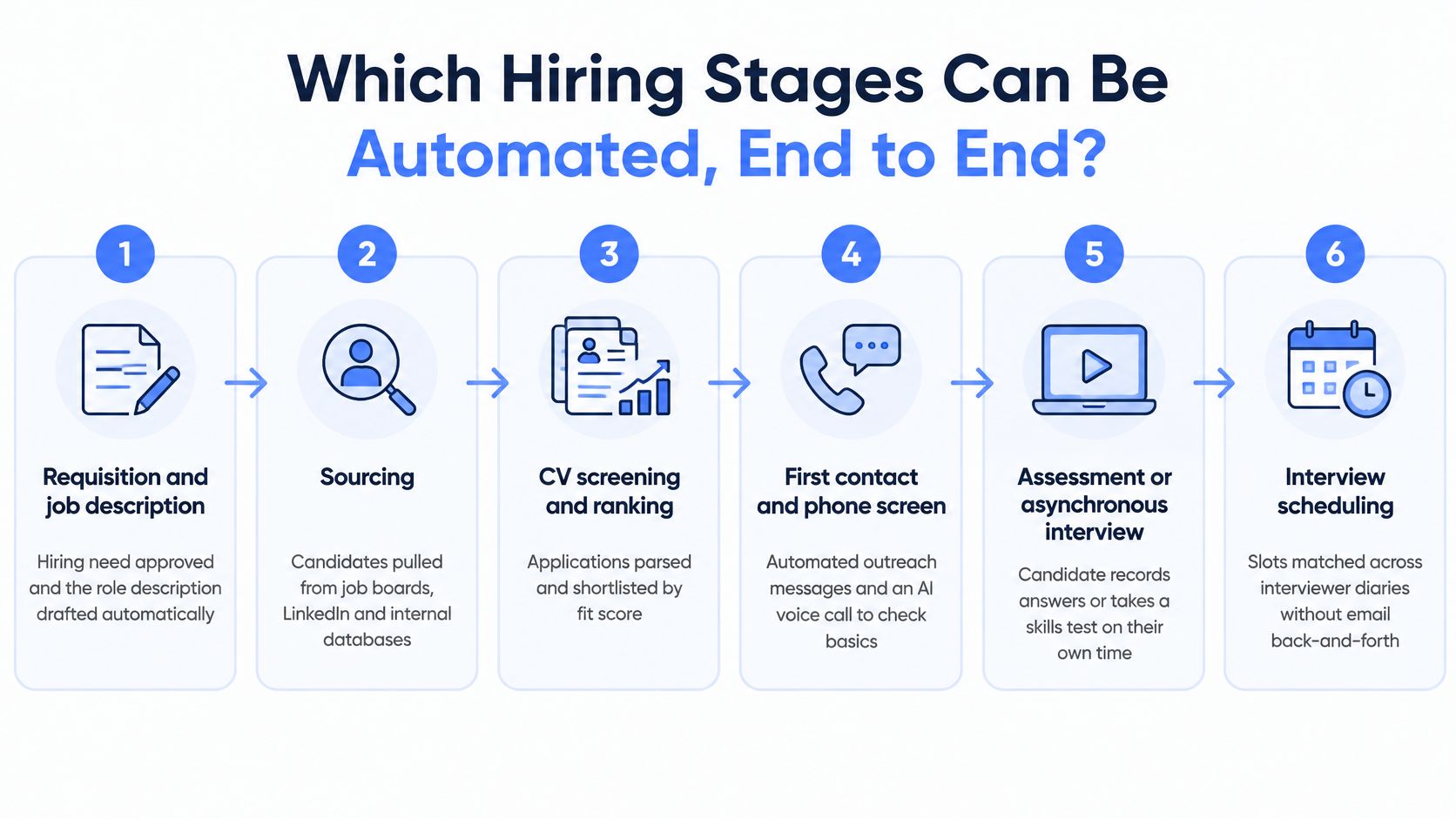
What should move automatically at each stage?
Hiring pipeline stages: manual work, automation and recruiter decisions
| Pipeline stage | Manual effort today | What automation handles | What recruiters decide |
|---|---|---|---|
| Requisition and job description | Rewriting JDs from old templates | Drafting JDs from a role rubric and hiring manager inputs | Approving must-have criteria and salary band |
| Sourcing | Searching channels individually | Searching several channels and the existing talent pool in one pass | Choosing which profiles to approach |
| CV screening and ranking | Reading hundreds of CVs against the JD | Parsing CVs and scoring against a role rubric with visible reasons | Setting thresholds and reviewing borderline cases |
| First contact and phone screen | Calling candidates, often without answers | WhatsApp outreach and structured calls in the candidate's language | Deciding which screened candidates advance |
| Assessment or async interview | Scheduling live rounds that clash with shifts | Sending asynchronous questions and scoring against a scorecard | Judging answers the scorecard cannot capture |
| Interview scheduling and notes | Exchanging emails for slots, typing notes later | Calendar booking and live or structured notes | Interpreting interview evidence |
| Hiring manager review | Writing summaries and chasing feedback | Standard packs containing scores, transcripts and next steps | Final shortlist and interview decisions |
| Offer and onboarding handoff | Managing letters and joining checks in parallel emails | Status updates and candidate data synced to the ATS | Offer terms, approval and joining verification |
The table is an operating reference, not permission to remove approvals everywhere. A system can prepare a job description, but the hiring manager still needs to distinguish a genuine qualification requirement from a preference inherited from an old template.
For designing those transitions, MyCulture.ai's guide to automating your hiring workflow provides useful context. Screening needs its own implementation discipline, including the extraction and scoring considerations in this guide to AI resume screening.
What does a connected candidate journey look like?
Consider a candidate entering through a career page, LinkedIn or a referral. In Stella's pipeline, CV scoring and ranking lead to WhatsApp engagement and an AI phone screen, followed by an asynchronous video interview on day 2 and hiring manager review on day 3.
That sequence describes the workflow, not a guaranteed hiring deadline. An unavailable candidate, incomplete assessment or low-confidence answer should trigger a hold or escalation, rather than an unexplained stage change.
For an Indian pharma plant, a candidate's stated shift availability should accompany the assessment. The hiring manager shouldn't need another call to recover information already collected, and the recruiter shouldn't need to retype it into the ATS.
Which AI Capabilities Matter and Where Humans Decide
The most useful AI capability is one whose output a recruiter can challenge. A ranking without reasons or an interview summary without supporting evidence makes review harder, even when the interface looks efficient.
The division below separates automated work from accountable judgement.
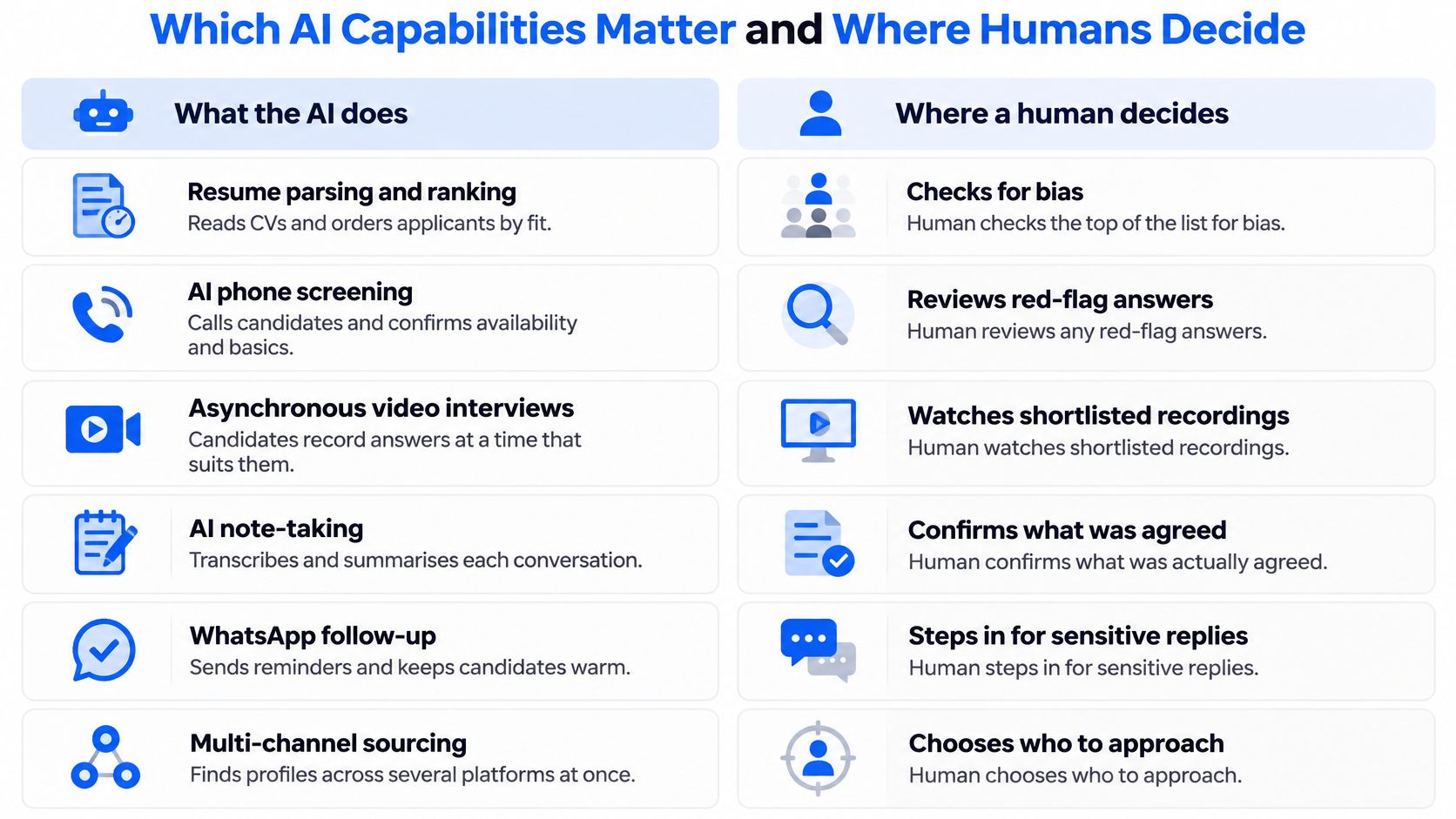
Where does each capability fail?
| Capability | Useful output | Typical failure | Human checkpoint |
|---|---|---|---|
| Resume parsing and ranking | Extracted experience and rubric-level scores | Missing practical skills described in an unfamiliar CV format | Compare extracted evidence with the original CV |
| AI phone screening | Structured answers about eligibility, location and availability | Mishearing code-switching, names or notice periods | Review uncertain answers against the recording |
| Asynchronous video interviews | Comparable responses to job-relevant questions | Treating connectivity or presentation polish as capability | Assess answer content and offer an accessible alternative |
| AI note-taking | Searchable transcripts and structured summaries | Turning a tentative answer into a firm commitment | Confirm important statements before acting |
| WhatsApp follow-up | Reminders, responses and engagement history | Continuing reminders after a candidate raises a sensitive issue | Take over the conversation |
| Multi-channel sourcing | Relevant profiles across approved sources | Surfacing duplicates or outdated information | Check identity, relevance and permission to contact |
After an AI Call, the recruiter receives a scored summary, transcript, recording and recommended next step. The recommendation saves preparation time, but it doesn't establish that the underlying evidence is correct.
Rubric-based ranking should show criteria met, criteria missing and the evidence that changed the score. Missing evidence should remain distinguishable from demonstrated lack of skill.
Mercer | Mettl's India's Graduate Skill Index 2025 reported overall graduate employability of 42.6% in 2024, with Tier-2 colleges at 46.1% and Tier-3 colleges at 43.4%, according to the Graduate Skill Index report. Those group-level measures aren't a basis for rejecting an individual; employers need role-specific evidence rather than college-brand shortcuts.
What should a defensible evaluation include?
A campus analyst rubric might assess spreadsheet reasoning, numerical accuracy and explanation of assumptions. A production operator rubric should assess relevant equipment exposure and safe working practices, not polished English unless the job requires it.
The AI hiring insights from Turn On Work offer additional context for evaluating AI-assisted recruitment. Procurement discussions should move beyond feature availability to these questions:
- Training: What examples and languages informed the capability?
- Testing: How was accuracy assessed for the employer's role family?
- Auditability: Can reviewers retrieve the evidence behind an output?
- Uncertainty: What happens when the system cannot assess an answer reliably?
A product demonstration can help teams inspect the candidate-to-recruiter handoff rather than judge voice quality alone.
Ranking and explanation should support review, not become an invisible rejection mechanism. Recruiters remain responsible for thresholds, exceptions and final selection.
How Automation Works in Real Indian Hiring Scenarios
Hiring geography changes the workflow. Software and IT-specific hiring in smaller cities grew by more than 50% in January–June 2025 against the same period a year earlier, according to TeamLease figures reported by The Economic Times.
The following are illustrative operating scenarios, not vendor case studies. Their channel and volume patterns describe the situations being modelled, not market benchmarks.
Three Indian hiring scenarios and the role of automation
| Scenario | Typical volume and channel | Where automation helps | What stays with recruiters |
|---|---|---|---|
| Frontline factory hiring for operators and helpers | A hypothetical intake of hundreds of applicants a week, mainly WhatsApp and phone, regional languages | Candidate-language outreach, availability and shift capture, initial screening | Document verification, joining decisions and shop-floor shift fit |
| BFSI branch hiring for sales and service roles in a tier-2 city | Steady flow across branches, mixed campus and lateral candidates | Scheduling, location and shift filters, structured screening calls | Sales aptitude, offer terms and branch manager interviews |
| IT services lateral and campus hiring | Waves tied to project starts and campus calendars | Skill screening, notice-period capture, scheduling and handoff notes | Technical depth, offer negotiation and offer drop-offs |
How does frontline hiring change the design?
For operators and helpers at a factory, remove repeated availability calls first. Candidates may prefer Marathi, Gujarati or Hindi, and shift preferences can change after a discussion with family or a current supervisor.
The workflow should confirm the latest preference before booking, not treat an old answer as permanent. Recruiters still verify documents and resolve whether the actual shift arrangement fits the candidate.
What matters in BFSI and IT services?
For a tier-2 BFSI branch, an otherwise suitable applicant may be unable to commute to the assigned location. Capturing branch preference, notice period and working hours before manager interviews prevents avoidable scheduling work; sales aptitude still needs human assessment.
In IT services, automation can capture availability and organise assessment evidence, but keyword overlap doesn't prove technical depth. Recruiters and technical panels need to resolve conflicting evidence, while offer negotiations and competing-offer discussions require a person.
A separate documented business outcome provides context, not a promise: Vastu Housing Finance achieved a 60–70% reduction in recruiter screening time per role, with the first shortlist delivered in 1–2 days instead of 4–5. Another employer should establish its own baseline before adopting those figures as an expectation.
Across these situations, the operating requirement is consistent: carry the candidate's current information forward and assign exceptions to a named recruiter.
What Does Automation Need From Your ATS and Calendars?
Integration is the way systems exchange candidate records, scores and status updates without manual copying. A connector logo isn't proof that the exchange covers the fields or actions a hiring team needs.
An India-focused HR technology report found that 52% of organisations had implemented technology to improve recruitment, while 26% were incorporating AI for HR automation and talent management. The sensible sequence is to standardise records and workflows before adding more interpretation through AI.
Which systems should connect?
The usual integration map includes the ATS, career site, sourcing channels, recruitment inboxes, calendars, WhatsApp Business and the HRMS or onboarding system. Each connection needs a defined purpose, rather than unrestricted replication of every field.
Dassh AI layers AI on top of an existing recruiting stack and doesn't require replacement. CVs can be pulled from an ATS, an inbox or direct upload, with these sources continuously kept in sync; shortlists and structured insights return to recruiters and hiring managers through the connected workflow.
The ATS should remain the system of record. Supporting services may need processing copies, but the organisation should avoid a competing, unmanaged candidate database with different statuses and retention rules.
A useful review of ATS features should distinguish record storage from operational capabilities such as status updates, interview feedback and controlled access.
What should HR operations and IT test?
- Field direction and ownership. Identify which system owns contact details, notice period, application status and assessment scores. Specify what happens when an existing value changes.
- Duplicate handling. Test a referral and a career-page application from the same person. Merge identity carefully without erasing separate application histories.
- Failure and recovery. Disconnect a test integration, restore it and check whether pending updates recover without duplicate invitations. Assign an alert owner.
- Audit-log ownership. Document who can retrieve logs, where they're held and the approved retention schedule.
Calendar testing needs realistic exceptions too. A panel member may withdraw, a plant interviewer may work a different shift, or a candidate may reschedule after receiving confirmation.
A failed sync should become a visible work item, not a candidate silently waiting for a response.
Go live only when the team can identify the authoritative record, recover failed transfers and explain who owns the next action.
What Does DPDP and GDPR Require From Automated Hiring?
Candidate notice belongs at the start of the workflow, including outreach and referrals. A CV submitted for one role supports processing for that recruitment purpose; reusing the profile for unrelated roles months later needs a separate basis.
Taxmann's guidance on employee data and DPDP explains that a CV voluntarily submitted for a specified role can be processed for that recruitment purpose under India's Digital Personal Data Protection Act, 2023. It recommends candidate notice, role-relevant collection and separate treatment of rejected-candidate talent pools, with distinct consent where consent is the basis.
Consent and documentation should be visible parts of the operating process. Each automated handoff, from sourcing to screening to interview scheduling, should leave a record of what was collected, why, and who accessed it.
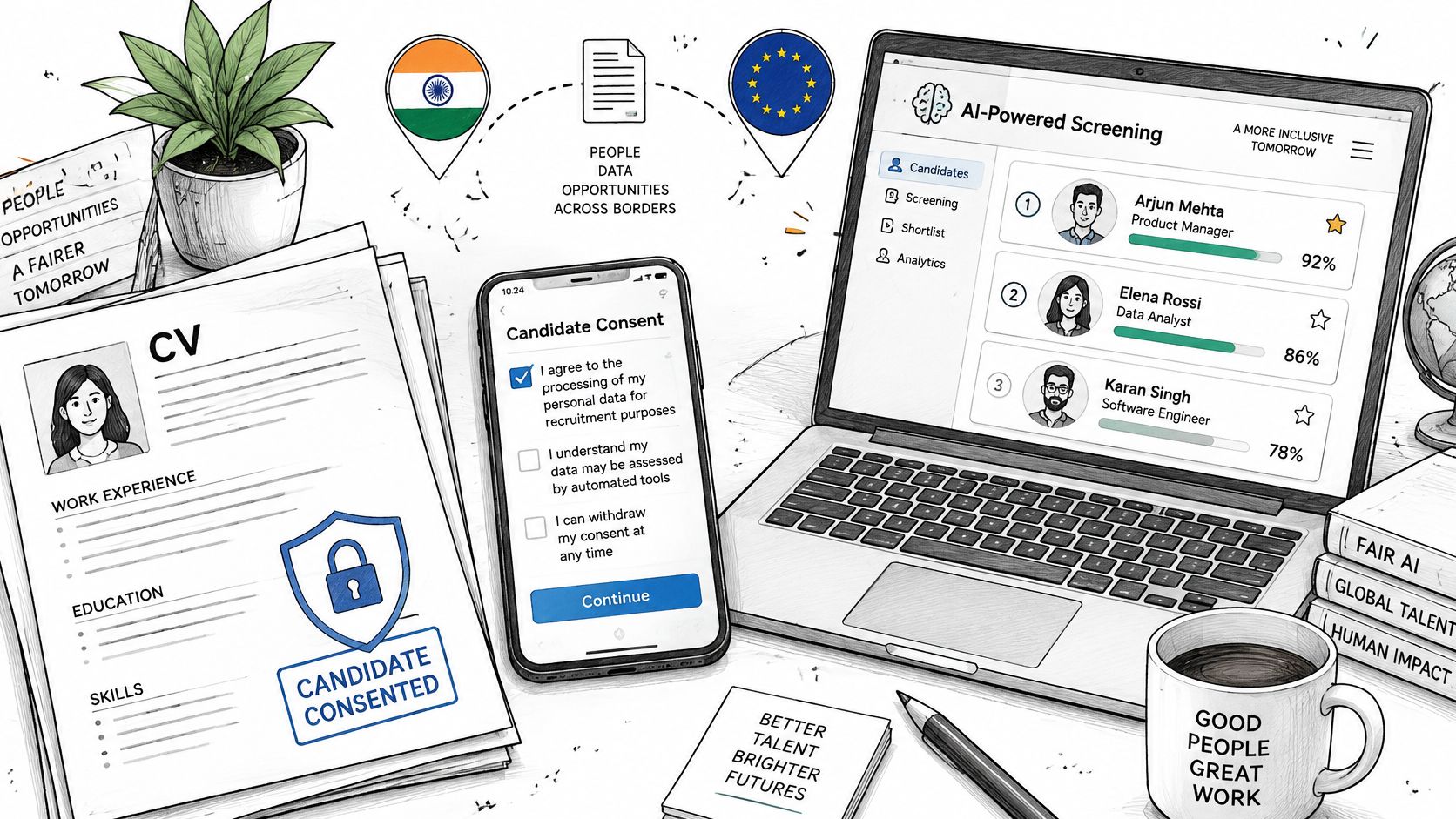
Which controls should HR and IT implement?
India employment data guidance from Cyril Amarchand Mangaldas supports purpose limitation, data minimisation and accuracy controls for AI-assisted recruitment. Those principles require more than a privacy statement attached to an application form.
| Control | Practical implementation |
|---|---|
| Purpose limitation | Record the role and reason for collecting each category of information |
| Access control | Restrict CVs, recordings and assessments to authorised recruitment participants |
| Security | Encrypt stored and transferred candidate material |
| Retention | Assign approved retention and deletion dates to records and recordings |
| Auditability | Log model outputs, recruiter edits and candidate communications |
| Correction and grievance | Provide an accessible route to challenge incorrect information or raise concerns |
Background verification should follow a conditional offer through a properly contracted agency. Retention schedules should reflect the original purpose and applicable legal, regulatory or contractual requirements, rather than a default of keeping everything.
A transcription error also creates a governance issue. If a candidate's notice period is recorded incorrectly, the organisation needs a way to correct it across connected records rather than fixing only the screen visible to the recruiter.
What should the candidate notice explain?
- Collection: The data collected, including recordings or transcripts.
- Purpose: Why it is needed and which hiring stage it supports.
- Access: The people and service-provider categories that receive it.
- Retention: How long it is kept, or the criteria used to decide.
- Rights and contact: How candidates can request correction or raise a grievance.
For cross-border hiring, counsel should determine whether GDPR applies; an EU connection requires a scope assessment, not an automatic assumption either way. Stated vendor controls such as GDPR compliance, SSO, SCIM, audit logs and regional data residency are worth checking against current documentation and contractual responsibilities before go-live.
The candidate data security whitepaper can support that review. This is general information, not legal advice; counsel should confirm applicable obligations, commencement provisions and implementation requirements.
Which Metrics Show Automation Is Working?
Recruiter hours saved is the easiest metric to report and the least useful alone. A faster screening process isn't successful if recruiters spend the recovered time correcting summaries or candidates stop responding.
Among Indian talent-acquisition professionals using or testing generative AI, 45% reported directing resulting time savings towards candidate screening and 32% towards skills assessment, according to LinkedIn's Future of Recruiting 2025 India report. Teams should therefore record where capacity goes, not just how much time disappears from a task.
A balanced dashboard puts efficiency beside candidate and hiring outcomes.
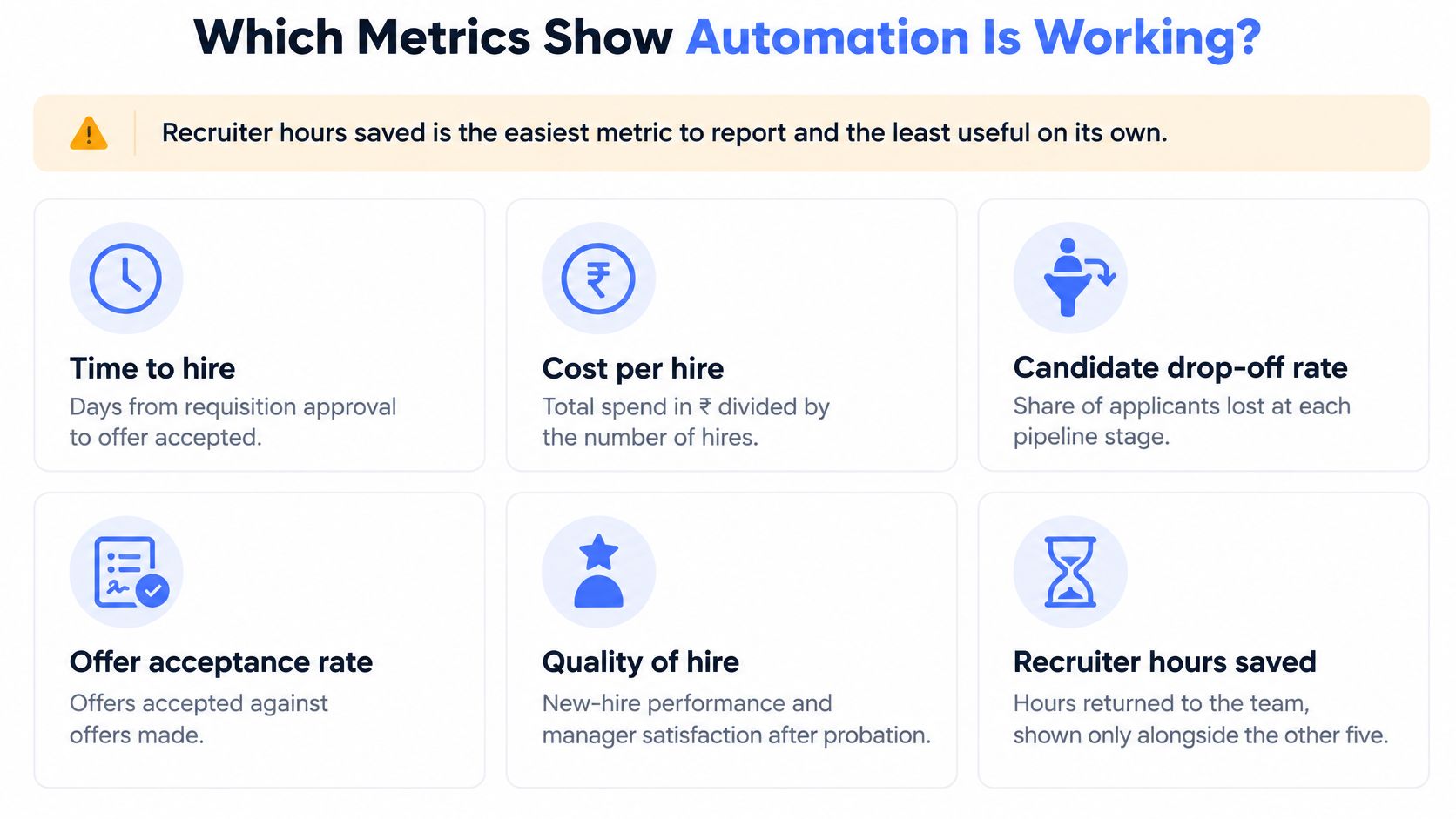
What should the operating scorecard measure?
Seven metrics to baseline before and after automation
| Metric | How to measure it | Baseline needed | Warning sign |
|---|---|---|---|
| Time to first shortlist | Days from requisition opening to first shortlist shared | Yes, comparable pre-launch requisitions | Unchanged after repeated role cycles |
| Recruiter hours per requisition | Logged screening, scheduling and note-taking hours | Yes | Hours shift to correcting automation |
| Screen-to-interview conversion | Candidates reaching interview divided by candidates screened | Yes | Conversion falls while volume rises |
| Candidate drop-off after first contact | Candidates who stop responding divided by candidates contacted | Yes | Losses concentrate in a language or channel |
| Offer acceptance rate | Accepted offers divided by offers made | Yes, for the same role family | Acceptance falls after faster but thinner screening |
| Override rate on AI rankings | AI-ranked candidates moved up or down by recruiters | Track from launch | Persistent or increasing overrides within a role family |
| Error gap across candidate groups | Compare false-negative rates across language, location and source groups | Yes, from sampled manual review | An unexplained gap persists or widens |
A shortlist delivered faster only counts if the hiring manager finds it usable. Hours per requisition should include exception handling and integration recovery, not just the tasks the system performs.
Conversion needs interpretation too. An increase can reflect better screening, but it can also follow a relaxed threshold; the team should inspect interview evidence before calling it an improvement.
How should teams interpret overrides and fairness?
An override rate is the share of ranked candidates whose position recruiters change. High overrides may indicate poor extraction, an unsuitable rubric or inconsistent reviewer judgement; low overrides may indicate sound ranking or uncritical acceptance.
Sample both accepted recommendations and rejected recommendations. Preserve the original CV, extracted fields, rubric version, score, confidence indicators and reviewer action separately so an auditor can reconstruct the decision.
Benchmark Hindi, Tamil, Telugu and other supported languages separately. Compare transcription quality, assessment errors and post-contact drop-off, while accounting for differences in role and channel.
Evaluation safeguard: A lower workload is not a successful outcome if qualified candidates become harder to identify.
Missing baselines should be marked not yet measured, never treated as zero. Vendor performance figures are prompts for investigation, not internal targets until the employer's own evaluation supports them.
Pilot One Requisition Before You Scale
A pilot earns trust only when it tests the platform the way the hiring team will use it. Set the evaluation criteria before any demonstration, so a polished walkthrough cannot shift the goalposts afterwards.
Platform evaluation scorecard for recruitment process automation
| Criterion | What good looks like | Red flag | Suggested weight |
|---|---|---|---|
| ATS integration depth | Two-way candidate, score and status sync | Manual export and re-import | Highest priority |
| Language coverage | Relevant languages with separate accuracy checks | English-only testing for regional hiring | High priority |
| Explainable scoring | Criteria and reasons visible for every score | An unexplained aggregate score | High priority |
| Human override and escalation | Logged changes and full-context takeover | Overrides unavailable or unrecorded | High priority |
| Data protection controls | Notice, restricted access, retention, logs and residency options | Undefined retention or missing audit trail | Mandatory gate |
| Fairness testing | Documented group-level error checks | No testing evidence | Mandatory gate |
| Commercial model | Clear outcome and time-saved measures | Hidden fees or ambiguous units | Supporting criterion |
These are suggested qualitative weights, not industry benchmarks. Security and fairness should operate as gates: strong convenience scores shouldn't compensate for a control the employer considers mandatory.
What should the demonstration prove?
Every provider should receive the same requisition and test cases. Include an unconventional CV, an unclear notice period, a regional-language response and a candidate asking to speak to a person.
Dassh AI integrates natively with 40+ applicant tracking systems. The implementation review should still confirm support for the employer's particular ATS version, custom fields and permissions, since a connector count proves breadth rather than fit for one specific stack.
Demonstrators should explain how capabilities were trained, tested and audited. They should also show the failed path, not just the smooth one: a garbled phone line, an incomplete CV, a candidate who switches language mid-call.
How should the pilot run?
- Choose a bounded role family. A repeatable branch-service or production hiring requirement is easier to evaluate than unrelated specialist vacancies.
- Agree the rubric. Recruiters and the hiring manager should label must-haves, preferences and evidence requiring clarification.
- Establish a baseline. As a suggested pilot design, collect four to six weeks of comparable pre-automation records, extending the window if requisition volume is insufficient.
- Run a controlled comparison. A suggested four-week parallel pilot can expose operational problems without removing the existing process prematurely.
- Review weekly. Score the pilot against the agreed evaluation metrics rather than impressions from individual cases.
- Make an explicit decision. Extend, adjust or stop according to the agreed success criteria, with unresolved risks assigned to owners.
Those durations are planning recommendations, not evidence-backed guarantees of an adequate sample. Low-volume hiring may require a longer evaluation.
A candidate screened in Hindi or Marathi shouldn't have to repeat the same facts when a recruiter takes over. When a conversation needs human attention, the escalation should pass the exchange to a recruiter with full context, so the handoff reads as one continuous thread to the candidate.
The decision to scale should rest on the employer's baseline and reviewed evidence. A convincing demonstration is only the beginning.
What Do Employers Ask Most About Recruitment Process Automation?
Is recruitment process automation the same as an ATS?
No. An ATS maintains application records; automation executes repeatable actions around those records. Employers should evaluate the quality of the connection between them, not assume either category provides everything. Dassh AI layers automation on top of the existing stack, so the ATS stays the system of record while scorecards, status updates and candidate data sync back into it.
Can AI reject candidates automatically?
Systems can be configured to make stage decisions, but employers shouldn't confuse technical capability with an appropriate policy. Recruiters should own rejection rules, review uncertain cases and confirm the legal approach with counsel. A defensible setup keeps a human accountable for every rejection the system issues.
Can AI screen candidates in Hindi or regional languages?
Stella supports English, Hindi, Tamil and Telugu, along with additional Indian languages; employers should confirm the full list during evaluation. Language availability isn't an accuracy guarantee, so scoring should be tested with representative candidate responses before go-live. A candidate screened in one language shouldn't lose context when the conversation escalates to a recruiter.
Which hiring stage should employers automate first?
Start where repeatable work and preventable delays coincide. For a high-volume team, that often means CV screening and first contact, provided the role criteria and escalation rules are already clear. Screening is also where volume is highest, so early wins there build confidence for later stages like phone screens and video interviews.
How long should a pilot run?
Long enough to produce comparable cases against the pre-automation baseline, and to surface exceptions rather than only smooth runs. The pilot section above covers how to structure that window.
Which metric should employers track first?
Post-contact drop-off and ranking overrides, alongside recruiter effort. Together they reveal whether speed comes from a better process or from thinner evaluation and lost candidates. The metrics section explains how to read each signal.
Dassh AI offers Stella, an end-to-end AI recruiter connecting sourcing, screening, calls, interviews, notes, WhatsApp engagement and scheduling with existing hiring systems. Visit Dassh AI to book a Stella demo using a live requisition, and assess the handoffs, language performance and recruiter controls against the team's own scorecard.
Ready to put these ideas into practice?
See the Dassh.ai suite in action with a personalized demo.