

Full-cycle recruiting is one accountable process that runs from requisition approval through sourcing, screening, interviews and offer to the candidate's joining date, on one shared candidate record.
A hiring manager has approved a shortlist, interviews are complete, and the candidate has accepted. Yet the recruiter is still chasing documents, the compensation team hasn't resolved an exception, and nobody knows whether the candidate will join. That gap between a completed task and a completed hire is where full-cycle recruiting earns its place.
What Is Full-Cycle Recruiting?
Full-cycle recruiting connects the hiring workflow rather than adding more tasks to a recruiter's desk. It gives a named owner responsibility for moving a hiring need through evaluation, selection and joining, with the evidence and communication history intact.
Consider a manufacturer recruiting a maintenance supervisor. The sourcer identifies relevant plant experience, the screening recruiter confirms shift availability, and the technical panel assesses fault diagnosis. Those findings must reach the person preparing the offer, along with the candidate's pay expectations and availability.
The process resembles a relay team passing a baton with full context. Separate specialists can run different stages, but the handover must preserve what the next person needs to act.
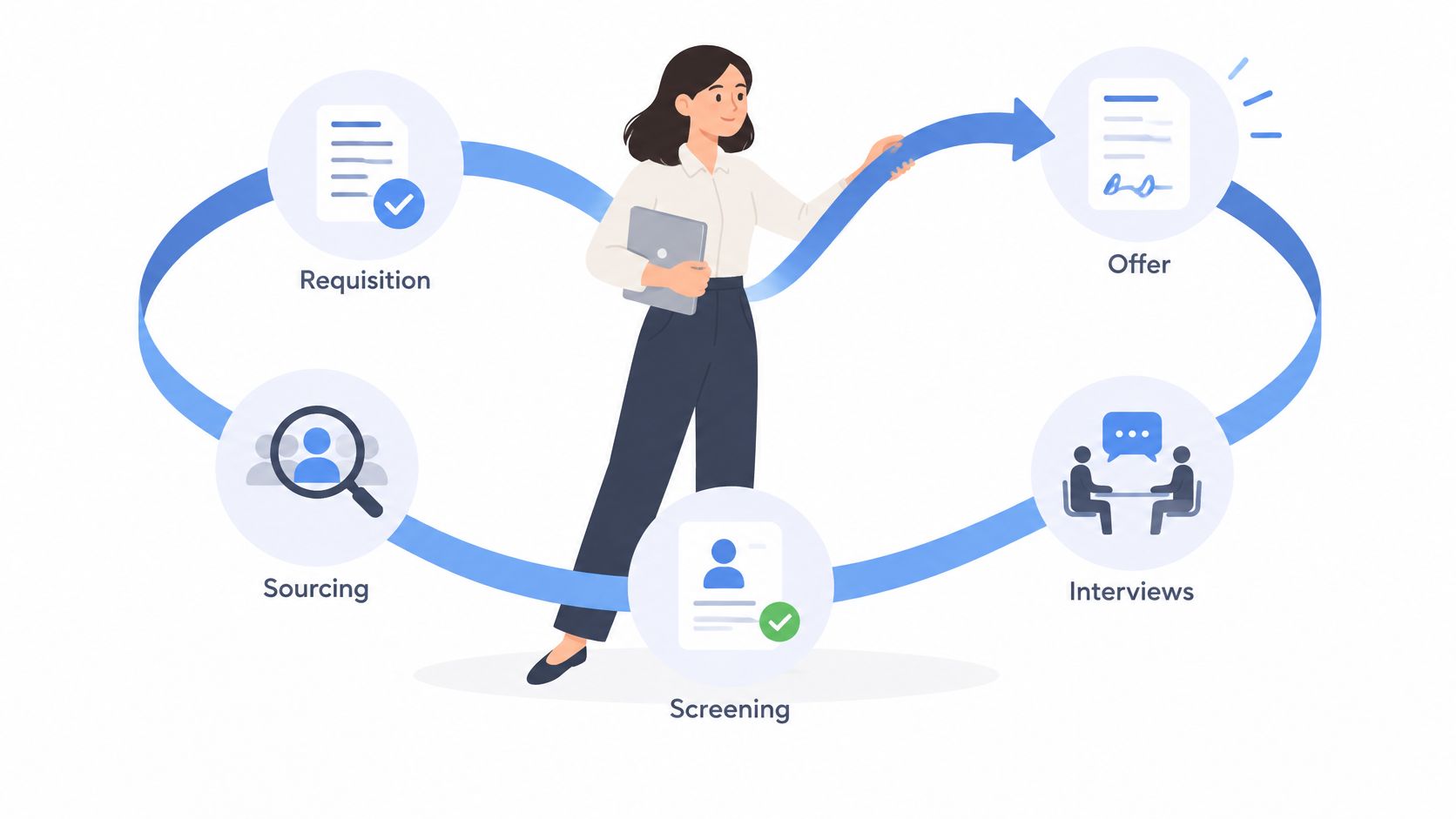
The illustration below shows the connected hiring journey.
Why does the model matter in India?
India's total employment increased from approximately 47.5 crore people in 2017–18 to 64.33 crore in 2023–24, according to official employment figures published by the Ministry of Labour and Employment. Employers operating across this workforce need a repeatable way to identify, qualify and convert candidates, not just collect applications.
A sourcing-only team can succeed against its target while the business still has vacant positions. An interview coordination team can complete every scheduled conversation while candidates wait indefinitely for decisions.
A full-cycle owner is judged against the hiring outcome: an accepted offer followed by a successful start. Applications received and interviews completed remain useful operating measures, but they aren't substitutes for that outcome.
What does a connected process change?
For a pharmaceutical plant, it means a candidate's qualification evidence reaches the technical reviewer. For a branch-based BFSI employer, it means location preferences and joining constraints remain visible through offer approval.
It also makes problems harder to hide. A delayed decision has an owner, a pending action and a candidate who needs an update.
Practical rule: If a candidate can fall through a gap between teams without anyone noticing, the process isn't yet full-cycle.
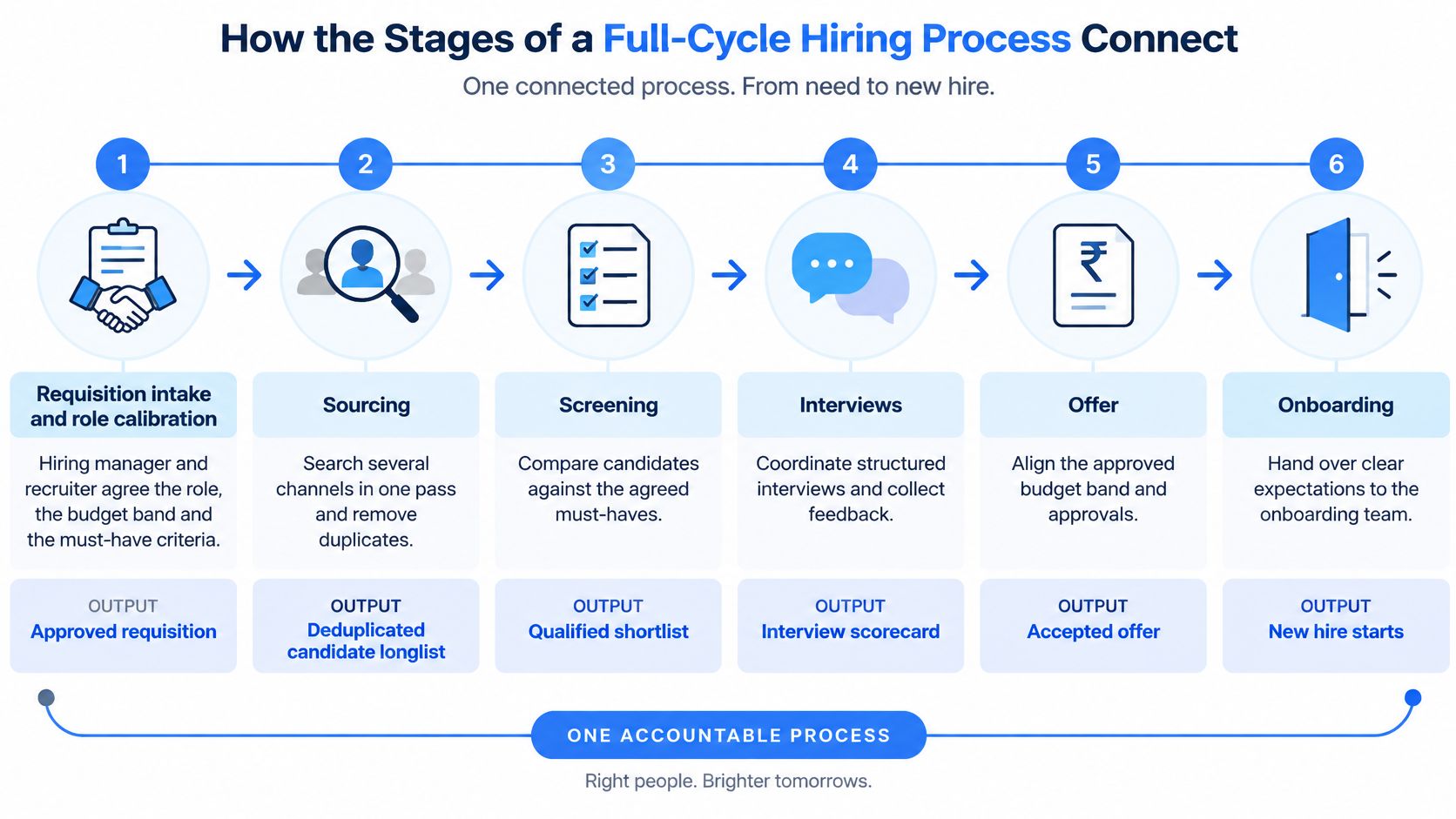
How the Stages of a Full-Cycle Hiring Process Connect
Each stage should produce something the next person can use. A status change alone isn't a handoff: “interview complete” says little unless the scorecard, recommendation and unresolved questions are attached.
The process diagram groups selection with the offer stage; operationally, keeping the selection decision explicit makes accountability clearer.
What should each stage produce?
Requisition intake and role calibration
The hiring manager and recruiter agree the role, budget band, must-have skills, work location and evaluation criteria before sourcing starts. The output is an approved requisition and role scorecard, including which requirements are required.Sourcing
Recruiters search career-page applications, professional networks, job portals, referrals and appropriately retained past applicants. The output is a deduplicated candidate longlist with source information, not disconnected spreadsheets.Screening and assessment
CV review tests the agreed criteria; phone screening confirms notice period, expected compensation, location and job-related language requirements. The output is a qualified shortlist with evidence, missing information and explicit reasons for exclusions.Interviews
Panels assess the same competencies using calibrated questions or relevant work samples. Each interviewer records evidence before the group discussion, producing completed scorecards rather than a retrospective consensus based on the most senior person's opinion.Selection
The hiring manager compares candidates against the agreed bar and resolves conflicting evidence. The output is a documented decision, including any conditions that must be satisfied before appointment.Offer management
HR and compensation teams secure pay approval, prepare the letter and support negotiation. The output is an accepted offer with a named owner for counteroffers, exceptions and joining-date changes.Handoff to onboarding
Recruiters coordinate joining documents, appropriately timed background verification and readiness with HR operations. The output is a confirmed start and a usable employee record, with outstanding items assigned rather than forgotten.
Can these stages run in parallel?
Yes, provided the team respects decision gates. Sourcing can continue while interviews are scheduled, and offer preparation can begin before final approval, but an unapproved offer shouldn't reach the candidate.
For example, a candidate journey can start with career-page, LinkedIn or referral sourcing, followed by CV scoring and ranking, WhatsApp engagement and an AI phone screen. An asynchronous video interview on day 2 and hiring-manager review on day 3 describe a configured workflow, not a guaranteed hiring deadline.
The video offers another view of the connected workflow.
The operating test is straightforward: can a recruiter see every stage, supporting evidence and pending action for a candidate on one screen?
Who Owns Each Stage of Full-Cycle Hiring
Full-cycle doesn't mean a recruiter must personally conduct every interview, approve compensation and create the employee record. It means an accountable owner coordinates specialists without losing responsibility for the overall timeline.
The following table separates decision authority from operational handoffs.
Roles, responsibilities and handoffs in full-cycle hiring
| Role | Owns | Hands off to | Key output |
|---|---|---|---|
| Hiring manager | Requisition brief, competency sign-off, final decision | Recruiter at shortlist stage | Approved role scorecard |
| Recruiter or TA partner | Sourcing, screening, scheduling, candidate follow-up | Hiring manager at review | Shortlist with evidence per candidate |
| Interview panel | Structured interviews and scoring | Recruiter for the decision record | Completed, timestamped scorecards |
| HR operations or compensation | Pay bands, offer approval, offer release | Recruiter for candidate communication | Approved offer letter |
| Background verification agency | Document and identity checks after a conditional offer | Recruiter and HR operations | Verification report |
| Onboarding or HRIS team | Joining documents, employee record, day-one setup | End of the recruitment cycle | Active employee record |
What must every handoff answer?
A hiring manager's decision authority doesn't remove the recruiter's obligation to chase a pending decision. Equally, a recruiter shouldn't promise compensation that the authorised approver hasn't cleared.
For intake discussions, Underdog.io's resource on talking compensation with hiring managers provides useful context for separating recruiter responsibilities from manager decisions.
Every transition needs explicit answers to these questions:
- Candidate record: Who maintains the current status and supporting evidence?
- Decision rationale: Who records why the candidate advanced, paused or exited?
- Follow-up and service level: Who takes the next action, and by when?
Say a plant runs a hypothetical 40-opening hiring drive. The recruiter manages sourcing through shortlisting, the plant manager returns technical scorecards within an agreed window, and HR operations coordinates joining documents and verification.
An RPO or staffing partner should use the employer's scorecard and status definitions. Otherwise, the employer receives a second pipeline that requires reconciliation rather than a managed hiring service.
The dangerous handoff occurs when a recruiter marks an offer accepted and assumes joining belongs entirely to HR operations. The rule should be one named full-cycle owner per requisition, even when several specialists perform the work.
Which KPIs Show Full-Cycle Recruiting Is Working
Applications, calls and scheduled interviews measure activity. They don't establish whether qualified candidates progress, accept suitable offers and arrive for work.
A useful dashboard combines elapsed time with stage conversion. The definitions below also prevent teams from comparing metrics that share a name but use different start points.
Full-cycle recruiting KPIs and what each one reveals
| KPI | How to calculate | What it reveals |
|---|---|---|
| Time to hire | Days from approved requisition to accepted offer | Overall cycle speed under this definition |
| Time to first shortlist | Days from requisition approval to first qualified shortlist | Sourcing and screening speed |
| Screen-to-interview conversion | Interviews divided by candidates screened | Screening quality |
| Interview-to-offer ratio | Offers made divided by interviews held | Interview bar and calibration |
| Offer acceptance rate | Accepted offers divided by offers made | Offer competitiveness |
| Offer-to-join conversion | Candidates joined divided by offers accepted | Notice-period and pre-joining risk |
| Candidate response latency | Hours between outreach and candidate reply | Early drop-off risk |
How should teams interpret cycle time?
TankhaPay's guide to average time to hire in India discusses hiring-cycle benchmarks and the need to examine individual stages. Without a clearly identified underlying report and year, a generic duration shouldn't become an enterprise service-level target.
Build the baseline by role family, seniority and location instead. A frontline branch opening and a specialist manufacturing leadership role shouldn't share an unexplained target.
Record timestamps for requisition approval, shortlist delivery, interview invitation, interview completion, feedback submission, offer approval and acceptance. Separate working time from waiting time: a recruiter may finish screening promptly while a panel slot remains unavailable.
For dashboard design, erecruit's discussion of prioritising decisions before BuyICT closes offers a deadline-led example of turning reporting into action. The transferable principle is to make pending decisions visible, not merely display totals.
What prevents faster hiring from becoming worse hiring?
Speed counts as improvement only when offer acceptance, early performance, retention and candidate experience remain stable. A faster shortlist is worthless if hiring managers reject it because the screening criteria were weakened.
Response latency deserves particular attention. When a previously responsive candidate stops replying, the recruiter should investigate rather than wait for the next scheduled reminder.
A practical review should include:
- Comparable cohorts: Separate campus, frontline, specialist and leadership hiring.
- Consistent denominators: Use the same candidate and interview counting rules.
- Actionable records: Connect overdue work to an owner and escalation route.
These ATS features for connected recruiting workflows matter because accurate reporting depends on reliable stage records.
Start with the last ten closed requisitions. Calculate the first four measures in the table, then identify where candidates spent the most time waiting rather than being evaluated.
How AI Supports Each Stage Without Replacing Recruiters
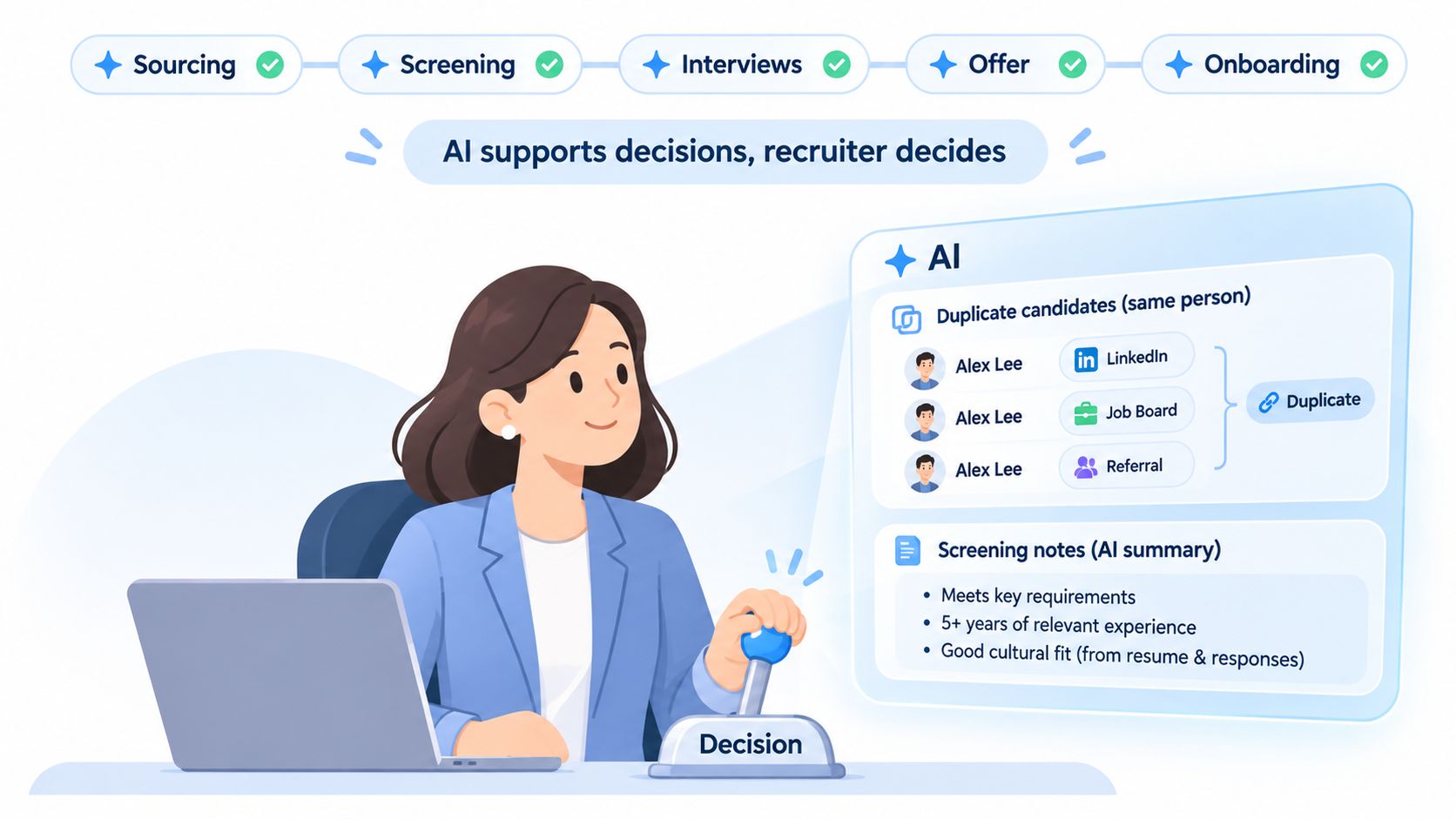
AI should support decisions instead of making them. Judge any tool on one test: can recruiters inspect its output, correct mistakes and keep decision authority?
Automation suits repeatable work with clear inputs. It suits ambiguous judgement far less: a patchy career history, a sensitive counteroffer conversation, a candidate who looks wrong on paper and right in person. Interpreting that evidence stays with the recruiter.
Which tasks can AI support?
- Sourcing: Search approved channels, remove duplicates and present a ranked list. A strong profile match still says nothing about candidate interest or permission for unrelated reuse.
- CV screening: Compare evidence against a role-specific rubric and show the reasons behind each score. Missing information should trigger clarification, not an invented conclusion.
- Phone screening: Confirm availability, expected pay, location and role requirements in the candidate's preferred supported language.
- Scheduling and follow-up: Offer calendar slots and send WhatsApp reminders, escalating to a recruiter when a conversation needs a human and carrying the full context across.
- Interviews and notes: Capture transcripts, organise competency evidence and prepare a consistent handoff for hiring-manager review.
Handoff design matters as much as the task automation itself. A cycle breaks where one stage's output fails to reach the next stage's owner, so stronger setups run one shared candidate record from first contact through to the joining date, which in Indian hiring is the finish line that counts.
Stella, the AI recruiting suite from Dassh AI, layers sourcing, CV screening, AI calls, asynchronous video interviews, an AI notetaker, WhatsApp engagement, scheduling and ATS integrations onto the existing recruiting stack through that shared record. Its sourcing searches Foundit and LinkedIn simultaneously in a single pass, deduplicates the results and scores every profile against the role before surfacing it. Calls and outreach support English, Hindi, Tamil, Telugu and additional Indian languages. After an AI call, the recruiter receives a scored summary, transcript, recording and recommended next step. Enterprise controls cover GDPR compliance, SSO, SCIM, audit logs and regional data residency, with deployment-specific settings still worth reviewing.
Which decisions must stay with people?
Recruiters and hiring managers retain hiring decisions, review borderline cases and approve exceptions. Language fluency should be evaluated only where it matters to the job; accent, recording quality or a transcription error should never become a proxy for competence.
Automation should make the evidence easier to inspect, not make rejection harder to challenge.
A sound recruitment process automation approach also includes a route to a human and an alternative when a candidate cannot complete the automated interaction.
What does responsible data handling require?
Taxmann's guidance on employee data and the DPDP Act, 2023 recommends clear candidate notices, collecting role-relevant information, appropriately contracted verification after a conditional offer, and distinct consent before retaining rejected applicants for a future talent pool.
Document scoring rules, access permissions, vendors receiving information and stage-specific retention periods. Recording and transcript collection need clear explanations too; an integration does not grant permission to copy candidate data indefinitely.
Where Full-Cycle Hiring Breaks Down in Indian Companies
An accepted offer can still become an unfilled position. Timelabs' discussion of HR workflows for Indian IT companies connects notice-period hiring risk with counteroffers and competing offers, making continued engagement a recruiting responsibility rather than optional courtesy.
The operational failure is treating acceptance as certainty. A candidate may still need release confirmation, relocation clarity or answers about compensation before committing to the start.
Full-cycle hiring symptoms, causes and fixes
| Symptom | Likely cause | Fix |
|---|---|---|
| Accepted offers fall through before joining | Counteroffers and competing offers during a 90-day notice period | Recruiter tracks notice length and last contact, schedules check-ins and escalates silence |
| Candidates go quiet between interview and offer | Slow handoffs and no named owner for follow-up | Assign a candidate owner and a WhatsApp or phone follow-up window |
| Time to first shortlist keeps slipping | Sourcing limited to metro job boards | Sourcing lead extends coverage to tier-2 and tier-3 pools with local-language outreach |
| Interview decisions differ across panels | No shared competency rubric or scorecard | Hiring manager requires role-specific scorecards with evidence for each score |
| Offer approval takes weeks | Unclear approval chain and no pre-approved pay bands | Compensation owner sets an approval target and pre-approves role bands |
What should happen between acceptance and joining?
Store notice length, competing-offer risk, last-contact date, documentation status and joining intent as structured fields. Notes buried in a conversation history can't reliably support an overdue-action queue.
Routine reminders can be automated. Counteroffer discussions, compensation exceptions and concerns about the new manager need a recruiter who can listen and make an authorised commitment.
Silence should trigger a proportionate response: check whether the candidate received the message, try the agreed alternative channel and escalate unresolved concerns. Repeated automated messages aren't a substitute for a useful conversation.
Why do sourcing and evaluation still fail?
For distributed plant, branch and field hiring, metro-focused sourcing can miss candidates near the actual workplace. Mobile-first communication and local-language screening are practical options, particularly where candidates don't regularly use email.
The blue-collar recruitment workflow needs to make worksite, shifts, transport expectations and document requirements clear before interviews. More applicants won't repair an unclear job proposition.
Panel inconsistency needs a different fix. Hiring managers should calibrate sample answers and require evidence for scores, rather than ask recruiters to compensate by sending larger shortlists.
Joining rule: A candidate who has accepted remains inside recruitment until the start is confirmed and the onboarding handoff is complete.
Where Should a Team Start with Full-Cycle Hiring?
Start with one bounded bottleneck and expand after the rollout proves reliable. A modular rollout can begin with CV screening or AI calls, then widen once scorecards, escalation rules and ATS synchronisation hold up under real volume.
Useful employer hiring resources from LatoJobs can support process preparation, though the pilot still needs the employer's actual approval routes and candidate records.
What should a practical pilot include?
- Map the current workflow. Draw the path from requisition to joining date: stage owners, waiting points and where candidate information sits at each handoff.
- Choose the longest avoidable wait. Investigate approvals and interview-to-offer delays before assuming sourcing needs automation.
- Agree the controls. Set a shared scorecard, name the candidate-record owner and identify who reviews AI scores before any rejection.
- Run a 30-day pilot. Compare time to first shortlist, interview-to-offer ratio, offer acceptance and offer-to-join conversion with the baseline.
A short pilot may not capture joining outcomes for candidates serving longer notice periods. The accepted offer letter sits mid-cycle, and the actual finish line is the joining date. Keep tracking that cohort rather than declaring success from accepted offers alone.
Expand only when quality holds and recruiters can explain the decisions. AI works best when it supports judgement, while the named recruiter remains accountable throughout. Teams that run the connected suite this way handle 2× more active roles per recruiter without adding headcount.
What Do Readers Most Often Ask About Full-Cycle Recruiting?
Is full-cycle recruiting the same as end-to-end recruitment or RPO?
Full-cycle and end-to-end recruitment describe the same connected hiring approach. RPO is a delivery arrangement that can cover that entire cycle or selected stages; outsourcing doesn't remove the employer's responsibility for the scorecard and hiring outcome.
Does full-cycle mean one recruiter does every step?
Full-cycle means one process with clear stage accountability, not one person doing every task. A frontline hiring drive may have a recruiter managing the candidate queue, a hiring manager approving the scorecard, panel members interviewing, and HR operations handling offer and joining paperwork. The handoff matters more than the job title.
Does full-cycle recruiting work for high-volume frontline hiring?
It works when sourcing, screening and follow-up use consistent records and job-related criteria. A practical example is a multi-location drive where candidates come from a career page, LinkedIn and referrals, then move into CV scoring and ranking before outreach begins. Recruiters review the shortlist and exceptions instead of repeating every routine interaction.
Does a company need to replace its ATS?
Keep the ATS if it already holds the candidate record. An automation layer can work with the existing ATS, calendars and sourcing channels, with sourced, scored and engaged candidates moving into screening and call flows without manual handoff or data re-entry. The implementation still needs clear rules for which system owns each field, who updates status, and how changes sync back.
Can AI run full-cycle recruiting on its own?
AI can source profiles, score resumes against a role-specific rubric, run outreach, conduct an AI Call, and prepare a scored summary with transcript, recording and a recommended next step. Recruiters and hiring managers still own shortlisting, interviews, rejections and offers. In India, the finish line is the joining date, not the accepted offer letter, so someone must keep tracking candidate movement after acceptance. The employer also remains responsible for candidate notices, access, retention and applicable data-protection obligations.
Dassh AI offers Stella to connect sourcing, screening, interviews and candidate engagement while keeping recruiters in control of hiring decisions. Visit Dassh AI to book a Stella demo using an actual role, and examine how candidate evidence and follow-up move through to joining.