
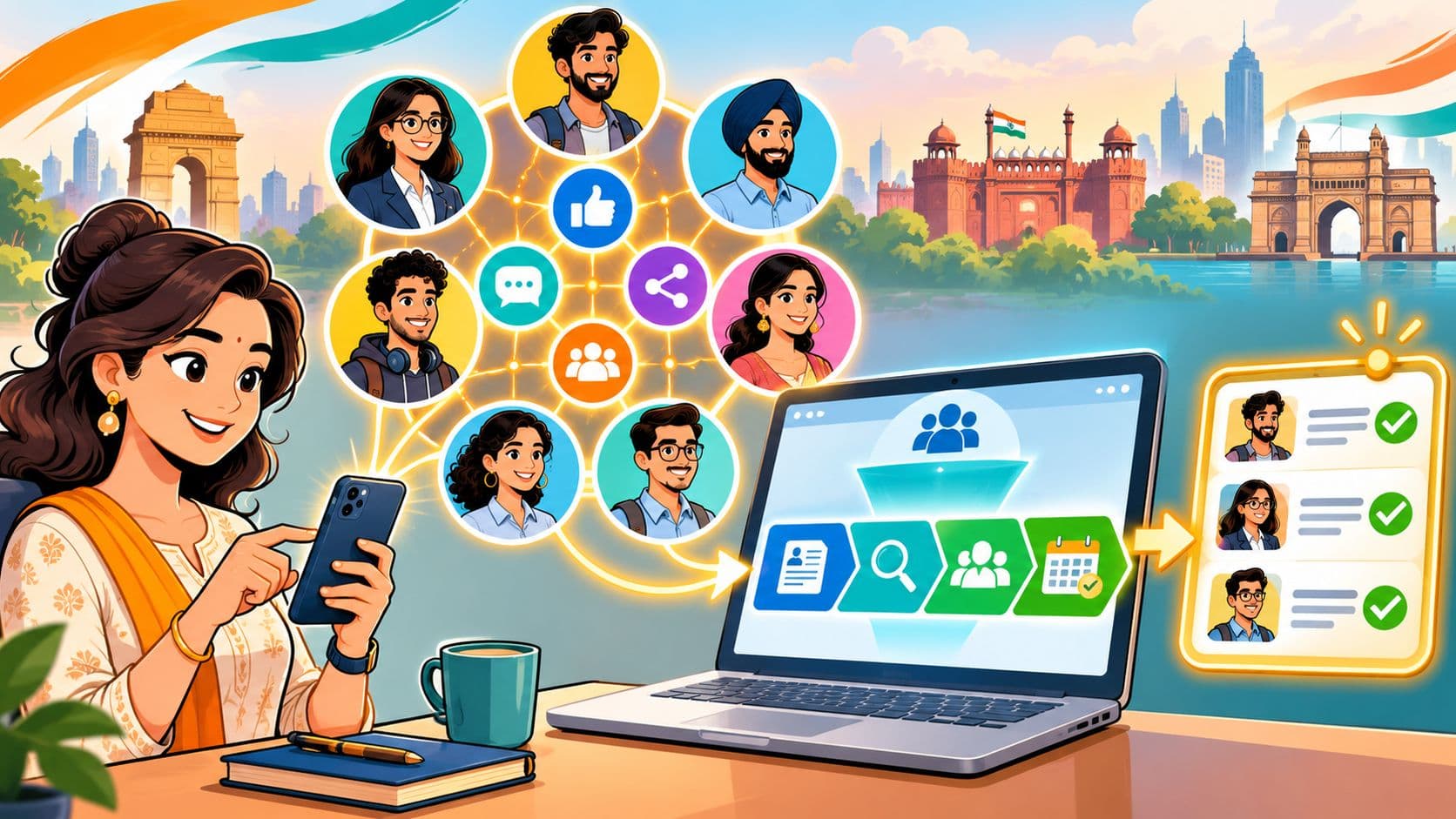
Posting more vacancies isn't a social media recruiting strategy. Social media recruiting uses networks such as LinkedIn, Facebook, WhatsApp, Instagram and X to find, contact and engage candidates. In India, it works best as a sourcing and engagement layer ahead of structured screening, not as the main application channel.
What Social Media Recruiting Can and Cannot Do
A candidate can notice an employer, research its working conditions and reply to a recruiter without wanting to apply through a social platform. Treating those behaviours as equivalent produces an impressive reach dashboard and an unreliable hiring forecast.
In Shine's Q1 2025 India Talent Insights report, candidates preferred job boards such as LinkedIn and Indeed at 25%, while social media was the least-preferred channel at 14%. Those are channel preferences, not source-to-hire conversion rates. They support a selective approach, not abandoning social recruitment.
Operating principle: Social gets the first reply. Structured screening and disciplined follow-up turn that reply into a hiring decision.
Where does social add hiring value?
For Indian enterprises, social deserves a defined job rather than a general mandate to generate applicants.
- Passive discovery: Identify employed specialists who aren't browsing vacancies.
- Local reach: Test frontline campaigns around specific plants, branches and tier-2 or tier-3 locations.
- Campus and referrals: Give employees and placement teams clear, shareable hiring information.
- Employer information: Explain shifts, travel, reporting relationships and workplace expectations.
- Candidate re-engagement: Reconnect with previous finalists when a suitable role opens.
For experienced hiring, RedactAI's guide to LinkedIn outreach to passive candidates offers useful context for approaching professionals who haven't expressed application intent.
The distinction between discovery and assessment matters:
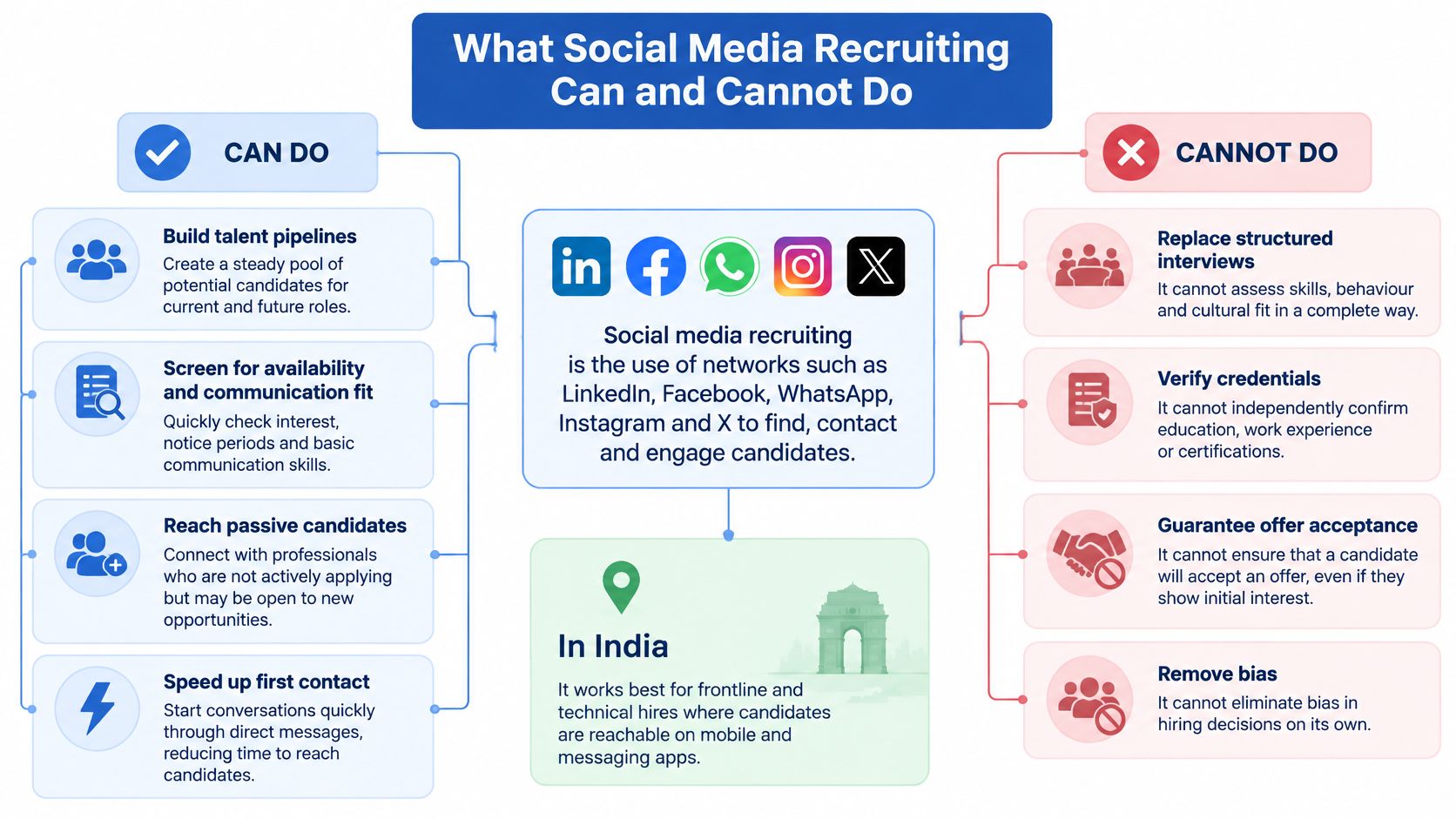
Social activity can't verify qualifications, replace structured interviews or guarantee that an offered candidate joins. A polished profile also isn't evidence of job performance, particularly for roles where online self-presentation has little connection to the work.
Choose channels using role family, language and relationship status. Is the vacancy frontline or specialist? Which language makes the conversation accessible? Is the candidate already known, or is this unsolicited contact?
Which Channels Work for Which Roles
Social channels by role family and realistic engagement
| Channel | Best for (role family) | Engagement approach | Realistic response |
|---|---|---|---|
| Experienced, technical, BFSI and pharma leadership | Skills-filtered searches, profile-based messages and job posts | Expect selective replies; test permission-based phone follow-up | |
| Facebook and Instagram | Frontline, field sales, campus and local talent pools | Regional groups, local-language images and short videos | Treat interest as unqualified until a phone screen confirms fit |
| Any role once the candidate is identified | Personal message with role, location, approved pay band and one question | Measure meaningful replies separately from delivery and read status | |
| X (Twitter) | Niche communities and employer-brand distribution | Hiring announcements, discussion threads and relevant community tags | Look for referrals and assisted discovery, not only applications |
| YouTube | Employer storytelling and campus drives | Role explainers in Hindi and regional languages | Attribute assisted conversions rather than rewarding views alone |
| Job boards alongside social | Volume applications across role families | Structured vacancy with clear location and compensation | Use as the application route and compare downstream qualification |
Historical adoption supports channel orchestration, not copying the same post everywhere. IBM's Smarter Workforce Institute country analysis reported use among Indian HR professionals and hiring managers of LinkedIn at 78%, Facebook at 67%, Twitter at 46%, YouTube at 26%, Google+ at 41% and Xing at 4%. These aren't current response benchmarks, and the inclusion of discontinued networks makes that distinction important.
What should change between channels?
An experienced pharma candidate needs evidence that the recruiter understands the therapeutic area, seniority and location constraints. A field-sales candidate needs territory, travel requirements, fixed versus variable pay and a straightforward next step.
WhatsApp should usually support an identifiable recruitment conversation, not become a destination for indiscriminate broadcasts. For unsolicited outreach, record the contact source and establish whether the candidate wants to continue before collecting screening information.
FoPost's explanation of how B2B teams use social channels is useful for adapting content to audience intent. Recruitment teams still need their own qualification criteria rather than borrowing marketing engagement targets.
For sourcing-system evaluation, Dassh AI's AI sourcing tools guide provides context. The practical selection test is whether sourced profiles become traceable, qualified conversations.
How to Run a Social Recruiting Campaign End to End
Start with the screening rubric, not the creative. A campaign can't compensate for unresolved requirements about location, shifts, experience or joining availability.
The visual summarises the campaign flow:
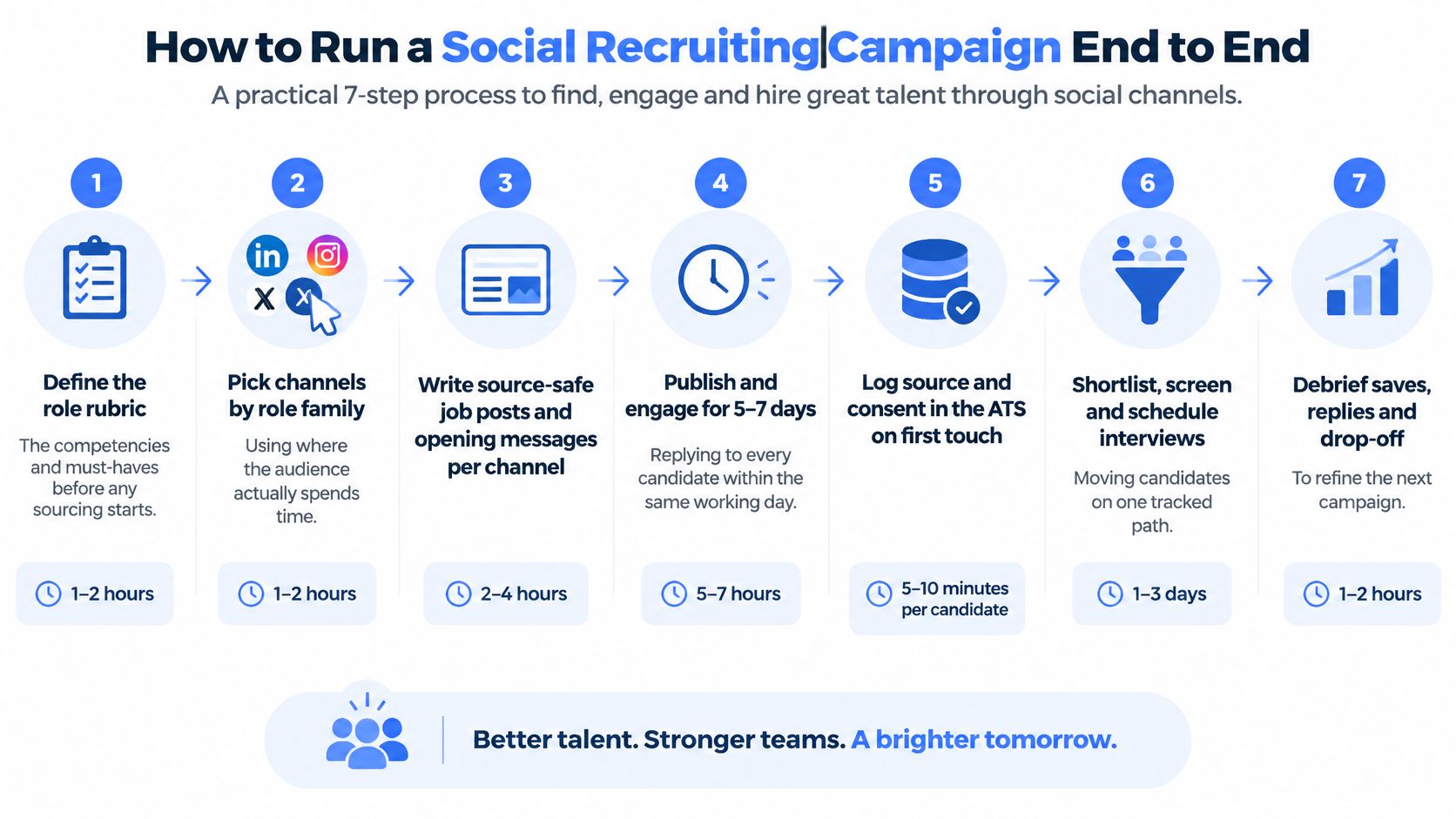
- Define the role rubric. Separate mandatory competencies from trainable skills and preferences.
- Choose channels. Match the role, geography, language and candidate relationship.
- Build the sourcing pool. Search professional databases, inbound applications, referrals and previous finalists.
- Deduplicate before contact. Assign ownership so separate recruiters don't approach the same candidate.
- Establish permission to continue. Explain the opportunity and move interested candidates into screening.
- Assess consistently. Combine CV evidence with a structured phone screen against the rubric.
- Schedule immediately. Offer available interview slots rather than starting another coordination thread.
- Record every event. Attach outreach, costs, replies and stage changes to the vacancy.
- Submit evidence with the shortlist. Give managers scorecards, uncertainties and availability constraints.
- Close the conversation. Notify unsuccessful candidates and obtain appropriate permission for future opportunities.
How can automation support the handoff?
Stella, Dassh AI's end-to-end AI recruiter, combines sourcing, CV screening, AI calls, AI interviews, an AI notetaker, WhatsApp engagement, scheduling and ATS integrations. Through LinkedIn and Monster partnerships, it can source from 100 million+ candidate profiles, or 10 crore+, while AI Sourcing searches Foundit and LinkedIn simultaneously, deduplicates results and scores profiles before surfacing them.
WhatsApp Agent escalates conversations requiring human judgement to a recruiter with full context. Automation should augment recruiter capacity, not remove accountability for suitability or candidate treatment.
When an AI call makes first contact, its opening sentence should identify it as an AI recruiter. Offer a human alternative and record permission in the ATS before asking screening questions.
The walkthrough provides additional workflow context:
For high-volume hiring, check notice period, expected joining date and interview availability separately. A candidate who fits the role but can't meet the hiring window shouldn't disappear inside a generic rejection category.
Measuring ROI Per Channel Without Fooling Yourself
Cost per qualified candidate measures sourcing efficiency against a defined threshold. Cost per hire measures the eventual acquisition cost, while time to first shortlist reveals operational speed. Progression rate tests whether early interest survives assessment.
Define qualified before launch. For a field-sales vacancy, that might mean the required territory, acceptable travel, relevant selling experience and alignment with the approved compensation band.
Per-channel social recruiting metrics and decision rules
| Metric | How to calculate | Compare against | Decision it supports |
|---|---|---|---|
| Cost per qualified candidate | Total channel spend / qualified candidates | Job-board and referral equivalent | Continue, rework or cut |
| Cost per hire | Total channel spend / attributed hires | Referral payout and agency fee for the same role | Whether acquisition is economical |
| Time to first shortlist | Days from launch to an agreed shortlist | Internal role target | Fix sourcing or screening delays |
| Progression rate | Interviews / qualified candidates; offers / interviews | Same role family through other channels | Whether quality survives assessment |
| Response rate | Replies / candidates contacted | Channel and language history | Which opening to retain |
| Language match effect | Response rate in selected language / English response rate | Comparable candidates in the same role and channel | Whether to extend language-matched outreach |
What does useful channel arithmetic look like?
Consider a hypothetical field-sales campaign costing INR 40,000 across content and paid placement. If it produces 200 replies, 60 qualified candidates and 12 hires, cost per qualified candidate is approximately INR 667, and cost per hire is approximately INR 3,333. These are illustrative calculations, not market benchmarks.
Include recruiter effort, screening charges and attributable follow-up costs when comparing alternatives. Log paid calls and profile views against the job; otherwise, the apparently inexpensive channel can hide substantial downstream work.
The historical LinkedIn recruitment-trends survey reported by The Economic Times found 44% of Indian recruiters used social and professional networks to hire quality talent in 2014, up from 36% in 2013. It also reported passive-candidate recruitment by 69% of Indian companies, behind China at 83% and the US at 72%.
Those figures establish historical adoption, not present-day ROI. PostNitro's guide to prove your social content impact offers useful attribution context, but recruitment decisions must ultimately use qualified progression and hires.
A reply is engagement. A qualified candidate is recruiting output. A joining employee is the business outcome.
Fitting Social Recruiting Into Your ATS and Automation
Recruiters lose attribution when a social conversation moves into an inbox, a personal WhatsApp thread or an unconnected spreadsheet. Without a shared record, another recruiter can repeat the outreach, and the eventual hire can appear under the wrong source.
Create or update the ATS record at first contact. Keep the original acquisition source separate from the subsequent engagement channel: discovering someone on a professional network and speaking on WhatsApp are different events.
The operating requirement is a shared candidate record:
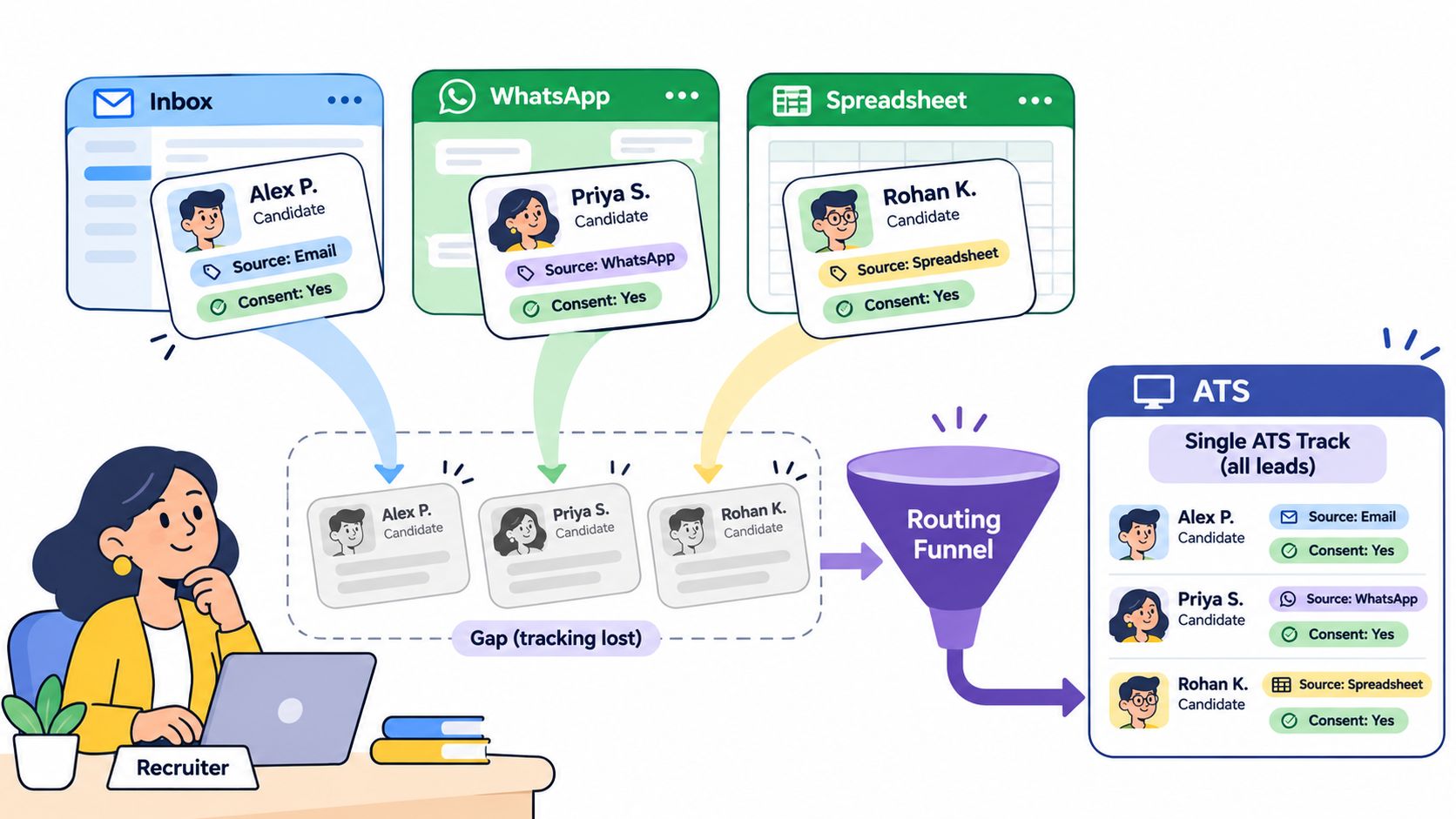
What information must survive every handoff?
| Field | Working requirement |
|---|---|
| Source channel | Preserve where the candidate was discovered |
| Campaign name | Attach the vacancy and outreach cohort |
| Consent status | Record the purpose, notice and candidate action |
| Engagement events | Retain messages, calls, scheduling and withdrawals |
Dassh AI integrates with ATS and HRMS systems through secure APIs and webhooks, with two-way transfer of invitations, scores and stages. Its integration coverage includes 40+ ATS connectors, allowing existing enterprise systems to remain the system of record.
Good recruitment process automation also needs exception handling. Candidates should be able to book inside chat, receive reminders and reach a recruiter when compensation, relocation or an assessment needs discussion.
Past applicants deserve attention before more acquisition spend. Dassh AI's sourcing process can surface previously unsuccessful ATS candidates whose experience fits a new vacancy.
Weekly check: Review duplicate contacts, missing consent records and unattributed hires alongside the shortlist report.
Structured scorecards should retain the evidence behind a recommendation, not just an overall score. A manager needs to distinguish an actual skills gap from missing information that a candidate could clarify.
Staying Compliant Under DPDP and GDPR
A public social profile isn't automatic permission for every downstream use. Where consent is relied on under India's DPDP framework, Vaish Associates' employment-data analysis explains that it must be free, specific, informed, unconditional and unambiguous, supported by clear affirmative action.
What should the recruitment checklist contain?
- Give an intelligible notice. Explain the personal data being processed, the hiring purpose, withdrawal route and complaint mechanism, including complaints to the Data Protection Board.
- Require an actual choice. Don't use silence, pre-filled fields or blanket permissions as substitutes for consent.
- Limit screening to professional evidence. India-focused cybervetting research published in Social Media + Society finds greater comfort with employer screening than among US respondents, but public availability doesn't eliminate context-specific privacy expectations.
- Document the reasoning. Tie adverse conclusions to job requirements and provide a way to correct information or challenge an inference.
- Set retention rules. Distinguish active recruitment from future talent-pool use, honour applicable withdrawal requests and define deletion responsibilities.
- Assess GDPR applicability. Where GDPR applies, map its obligations alongside DPDP rather than assuming an Indian workflow satisfies both.
Don't turn personal photographs, religion, family circumstances or political expression into informal suitability signals. A recruiter searching for a professional certification shouldn't export an entire personal profile into the hiring record.
Which enterprise controls deserve scrutiny?
Treat regional data residency, SSO, SCIM and audit logs as procurement requirements. Request evidence of applicable ISO certifications and review the scope of GDPR and DPDP controls rather than accepting a general compliance label.
Dassh AI's candidate data security whitepaper provides a starting point for that review. Legal and privacy teams should confirm applicable provisions, commencement requirements and processing grounds for the actual workflow.
A role-specific scorecard and controlled evidence trail are practical safeguards. Neither an AI-generated score nor a public source makes a hiring decision automatically fair.
What to Post and How to Open the Conversation
A WhatsApp opening should name the role, location and approved pay range, then ask one straightforward question. Don't make the candidate open a document to discover whether the opportunity is relevant. A long forwarded JD asks candidates to do the matching the recruiter should already have done. A generic opening also gives an employed candidate little reason to interrupt the working day.
Build the message around one decision
- Candidate name: Use the correct name and identify the recruiter or employer.
- Role title: State the actual vacancy, not a broad opportunity category.
- Location: Include the branch, territory or worksite and relevant travel requirements.
- Pay range: Insert the approved INR band, distinguishing fixed and variable compensation.
- One question: Ask whether the candidate is open to field-sales roles in Pune.
- Next step: After interest is confirmed, offer a call or bookable slot.
Use this template as a structure, not as a salary benchmark:
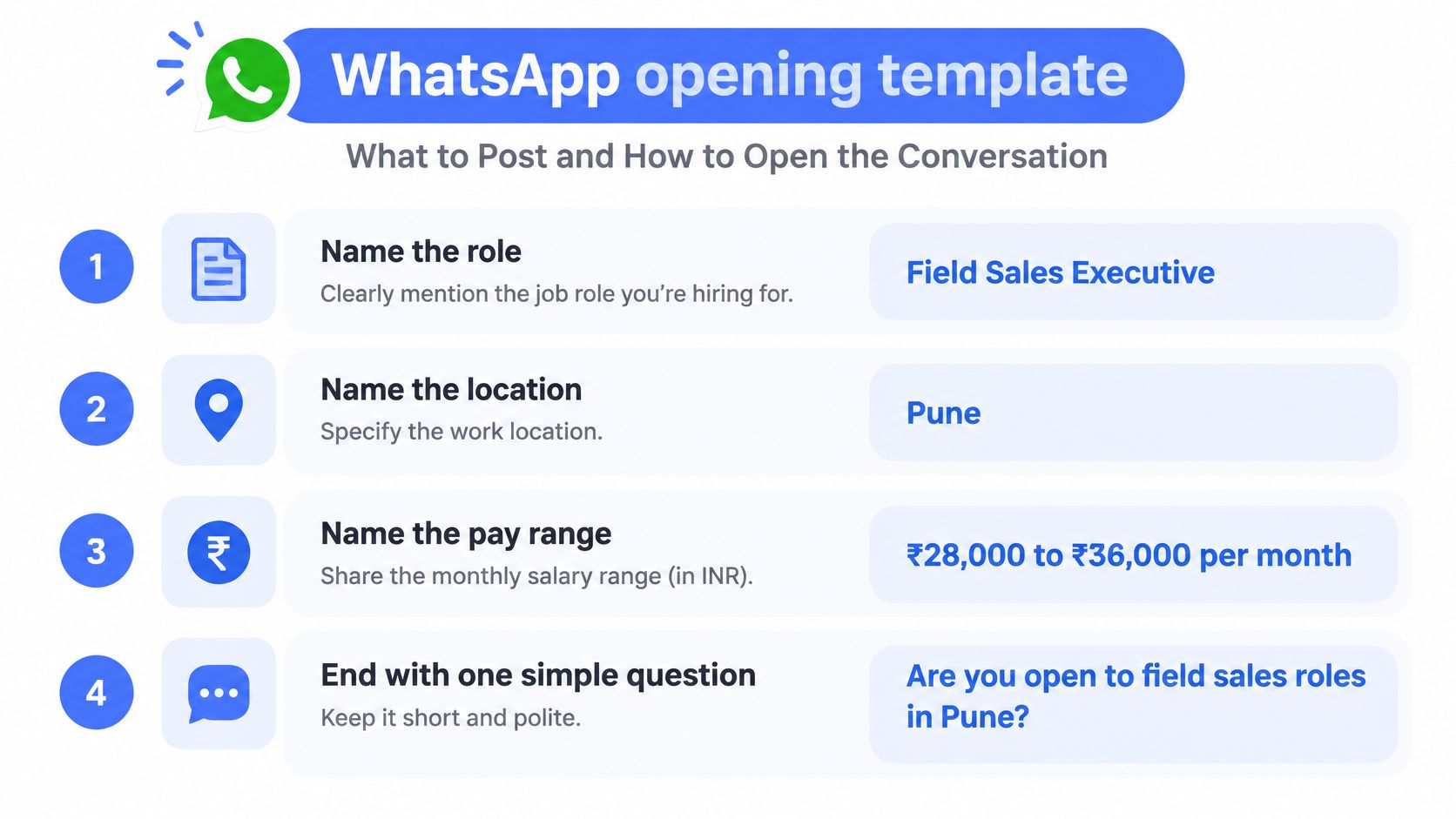
Keep the first message short enough to read on a phone screen and specific enough to answer the candidate's first question: is this role relevant to me? If the answer depends on shift, travel, compensation or eligibility, put that detail in the message. WhatsApp Agent can answer candidate questions instantly, let candidates book interview slots in chat and escalate to a recruiter with full context when a conversation needs a human touch. Use that handoff for exceptions, not as a substitute for a clear opening.
Match public posts to the channel
For LinkedIn posts, specify the role, city, experience requirements and application route. Recruiter posts should explain the work plainly. Employee referral requests should state eligibility, the approved reward in INR and the referral process.
For frontline drives, use local-language carousels or short videos explaining shifts, travel and workplace conditions. Don't use creative formats to hide difficult conditions that will emerge during screening. Public posts create interest; the screening step must still test the role-specific rubric.
Dassh AI supports multilingual conversations in English, Hindi, Tamil, Telugu and additional Indian languages. Language matching is an accessibility and engagement choice, not a proven performance lift for every role. Judge its value by completed screens and qualified progression, alongside the language comparison covered in the ROI analysis.
Short and specific beats long and polished when the candidate needs to make a simple first decision.
Your Next Step on Social Recruiting
The strategic choice isn't whether to maintain social accounts. It's whether social has a defined responsibility in the hiring operation.
| Approach | Appropriate when | Accountability |
|---|---|---|
| Keep social primarily for employer information | Application channels already provide sufficient qualified talent | Useful content and assisted discovery |
| Run a controlled sourcing pilot | Specific roles lack reachable candidates | Qualified pipeline and comparative acquisition cost |
| Automate the connected workflow | Recruiters spend substantial time coordinating repetitive tasks | Capacity, assessment consistency and candidate experience |
How should an enterprise run the pilot?
Choose a high-volume frontline role and an experienced role, then run a proposed eight-week pilot. Establish cost per qualified candidate, cost per hire, time to first shortlist and progression rate before launch.
Keep eligibility criteria stable and compare against job-board and referral acquisition for equivalent vacancies. Review location exclusions, notice-period constraints, interview attendance and offer drop-offs rather than assuming the source caused every loss.
Dassh AI's full-suite recruiter-throughput metric shows 2× more active roles per recruiter without added headcount, validated across Vastu Housing Finance, Buro Happold and Neo Wealth Management engagements. Its stated cost reduction is up to 70% compared with traditional recruiting; these are business outcomes to test against a team's own baseline, not guaranteed pilot results.
For a hypothetical TA team carrying 20 open roles across tier-2 locations, the relevant question is where recruiters need judgement and where administrative coordination consumes capacity. Preserve recruiter ownership of exceptions, hiring-manager calibration and candidate concerns.
Frequently Asked Questions
Is social media recruiting a replacement for job boards?
No. Job boards capture people already hunting for work, while social reaches passive candidates who never open a listing. Both feed the same funnel, and both need a structured application and assessment route downstream. Treating social posts as the application channel itself is where qualification data and consent records go missing.
Which channel should frontline hiring teams start with?
Start with a location-specific sourcing route and permission-based mobile engagement. WhatsApp is the channel where candidates open messages 98% of the time, and they can book interview slots directly in chat. Confirm territory, language, shifts and compensation alignment before scheduling interviews.
Can recruiters screen any information on a public profile?
Restrict assessment to evidence tied to the role-specific rubric, the same standard a formal application would face. Photos, political posts and personal life details sit outside job-related scoring, and an unstructured review of them creates exactly the inconsistency a rubric exists to prevent.
What counts as a qualified social recruiting lead?
A profile scored against the role-specific rubric, deduplicated against your ATS so past applicants do not surface twice, with consent captured in writing before screening data moves downstream. Engagement signals alone, a like or a message read, carry no qualification weight.
Should AI conduct the first screening call?
A voice agent can run a structured first screen and produce AI-powered scoring before a recruiter is ever involved, which is where the capacity gains come from. When a conversation needs a human touch, it should escalate to a recruiter with full context rather than dropping the candidate. Recruiters retain responsibility for exceptions and consequential decisions.
Dassh AI offers sourcing-to-shortlist automation that connects candidate discovery, multilingual engagement and structured screening with the existing ATS. Visit Dassh AI to book a Stella demo using the team's own roles and assess how the workflow would handle qualification, consent and recruiter handoffs.