

Many job posts soften field sales with phrases such as “some local travel” and “competitive salary.” That approach damages frontline hiring funnels across India. A strong field sales executive job description works in the opposite way. It states the territory, daily travel load, product line, local language, two-wheeler need, and INR pay split up front. Desk-role candidates opt out early. Experienced field sellers apply.
When a post hides daily beat visits or leaves out fuel allowances and incentive maths, the funnel fills with people who expect an office role. Recruiters then spend hours on screening calls. The few genuine territory sellers walk away once they hear the terms. A vague description loses the right candidates before the first call. Honest disclosure is the lever for better quality of hire.
What Does a Field Sales Executive Do in India?
A field sales executive in an Indian enterprise is a territory-facing revenue role responsible for visiting customers in person across a defined geography to generate orders, enrol new accounts, and expand territory sales. Performance is judged on observable commercial outputs such as qualified prospects, daily visits, orders booked, collections, and retention rather than desk administration.
According to Indeed's India sales executive guidance, core responsibilities span finding new business opportunities, contacting prospects, presenting products, negotiating prices and commercial terms, preparing contracts, tracking sales activity, and managing ongoing accounts. In practice, employers also expect CRM discipline, coordination with distributors or internal operations, and daily travel across assigned pin codes.
On the ground, that means product demonstrations happen across a retail counter, in a factory purchase office, or at a doctor's clinic between patient appointments, never over a slide deck.
Five Indian Field Sales Roles Sharing One Title
Hiring managers frequently make the mistake of reusing one generic description across completely different selling motions. In India, five distinct roles carry the same title yet demand very different daily habits:
- Route-based FMCG and distribution sales: The executive follows a fixed weekly beat covering kirana stores, wholesalers, and modern trade outlets. Managers track numeric distribution, outlet coverage, and secondary order value.
- Consultative B2B and industrial sales: Instead of dozens of short stops, the seller runs fewer, longer meetings with factory owners, procurement heads, or facility managers, with targets tied to qualified pipeline and deal closure.
- BFSI product sales: Executives sell home loans, insurance policies, merchant payment solutions, or wealth products through direct visits, branch referrals, and channel partners, measured on disbursals or policies issued.
- Pharma and medical field sales: Built around disciplined daily doctor calls, chemist checks, and sample detailing across a hospital or clinic cluster, evaluated on productive calls per day and prescription share.
- Telecom and device field sales: Focused on retail outlet visits, counter branding, distributor coordination, and customer or retailer enrolment drives, where stock availability and new activations drive monthly payouts.
The mix of sales hiring in India is shifting too. A 2024 WorkIndia report covered by Rediff noted that openings in modern sales channels such as telecalling and business development grew by 34%, while traditional retail and field-sales openings declined. That makes precision on product category and territory far more important than the job title itself.
Hiring reality: Product line and territory beat job title every time. A seasoned home-loan executive won't ramp quickly on wealth management, just as a dermatology representative can't move into cardiology without rebuilding doctor relationships from scratch.
Notice what the five roles share. Every one of them puts the seller on the road for most of the working week, and every one of them ties monthly earnings to what happens inside a defined geography. Yet the daily rhythm differs so much that a strong performer in one motion can fail outright in another. This is why the first question a serious candidate asks is never about the company. It is about the beat: which pin codes, how many outlets, what product, and how far the furthest stop sits from home.
Teams hiring frontline sellers across tier-2 and tier-3 belts face many of the same ground realities covered in this guide to blue-collar recruitment in India, from hyper-local sourcing to first-month retention. Once those field teams are hired, keeping momentum high through clear recognition and territory coaching matters just as much, as outlined in this resource on boosting sales team engagement.
Ready-to-Copy Field Sales Executive Job Description Template
Two recurring errors push top field candidates out of Indian hiring pipelines. The first is writing "some travel required" for a job that puts someone on the road five or six days a week. The second is leaving out fixed pay, incentive mechanics, and travel allowances while padding the page with corporate jargon and degree filters.
As Indian HRM's field sales executive profile highlights, day-to-day execution often involves beat planning, GPS check-ins, roughly 25 to 40 calls per day, smartphone sales-force apps, local-language pitching, zero-order reporting, and margin or scheme calculations. Candidates need to see that reality in black and white before applying.
Replace vague corporate copy like "Drive business growth across assigned markets" with concrete field copy: "Visit 25 to 30 outlets a week in the Pune east beat and enrol four new retailers each month." Swap every example figure below with your company's actual territory numbers.
Ten Fields to Copy and Customise
Paste the ten numbered fields below into your careers portal and job boards, filling in the bracketed details for each territory:
- Job Title and Reporting Line: Field Sales Executive ([Product Category / Business Unit]), reporting to the Area Sales Manager ([Region]).
- Headquarters Town and Territory: Based in [Headquarters Town, e.g., Nashik], covering [named districts, talukas, or pin-code clusters, e.g., Nashik Urban, Sinnar, and Igatpuri].
- Time in the Field: [4 to 5] out of [6] working days spent on direct customer visits within the assigned territory; [1] day for distributor review, pipeline planning, and weekly reporting.
- Product Line and Buyer Type: Selling [exact product or service, e.g., commercial vehicle loans / OTC pharma range / industrial fasteners] directly to [exact buyer, e.g., fleet operators / retail chemists / plant procurement teams].
- Daily Activity Expectation: Complete [insert realistic number, e.g., 15 to 20] planned in-person visits or customer calls per day, covering a mix of existing accounts and new prospects.
- Core Responsibilities:
- Plan the weekly beat: Sequence outlet or client visits by geography and revenue potential each Monday morning.
- Visit and enrol new accounts: Pitch the product range in person, handle price or margin objections, and complete customer or retailer onboarding.
- Book orders and manage stock: Capture orders on the mobile field app, check shelf or stock availability, and push active trade schemes.
- Follow up on payments: Track overdue invoices with accounts and coordinate timely collections within agreed credit terms.
- Submit daily reports: Log every visit, order value, and zero-order reason on the CRM or field app before end of day.
- Coordinate with distributors: Align dispatch timelines, resolve delivery gaps, and relay competitor pricing and display activity back to the area manager.
- Requirements: Prior experience selling [same or comparable product category], residence or active working knowledge in [Territory], fluency in [Local Language(s)], valid driving licence with own two-wheeler (if beat coverage requires it), and verifiable past performance against monthly targets.
- Compensation and Allowances (INR): Fixed salary of INR [X to Y] per month, plus performance-linked monthly incentives of up to INR [Z] on hitting named targets. Separate field allowances include INR [A] per kilometre or INR [B] monthly two-wheeler fuel reimbursement, plus INR [C] monthly mobile and data support.
- Languages Required: Spoken fluency in [Primary Territory Language, e.g., Marathi] and working proficiency in [Secondary Language, e.g., Hindi or English for reporting].
- Key Performance Indicators: Measured monthly on [insert target] productive visits per day, [insert target] new outlets or accounts enrolled, [insert target] primary or secondary sales value in INR, [insert target]% on-time daily reporting, and collections within the [X]-day ageing window.
Pre-Publish Sanity Check for Recruiters
Before any job post goes live, ask whether a field seller reading it on a phone screen can answer four questions in thirty seconds: where they'll travel, how many days a week they'll spend on the road, what they'll take home in fixed pay plus allowances, and how their monthly target is calculated. Talent leaders building distributed commercial teams can also review practical frameworks to hire sales representatives that keep role expectations anchored in territory mechanics rather than generic personality traits.
Must-Have and Nice-to-Have Skills for Field Sales Hiring
Every field sales screening process should start with three essentials before looking at anything else: genuine readiness for daily field work, experience selling the same kind of product, and first-hand territory knowledge backed by local language fluency and a two-wheeler with a valid licence. Everything else is secondary.
Clarity on skills matters more than ever in India's sales talent market. In a 2024 upGrad Enterprise survey of more than 3,900 sales professionals reported by The Economic Times, 80% of Indian sales professionals said they lacked the skills needed to thrive in a rapidly changing work environment. Listing vague traits like "dynamic go-getter" won't separate candidates who can run a beat from those who struggle once they leave the office.
Grounding Skills in Observable Standards
Rather than inventing abstract competencies, Indian HR teams can adapt the structure of the Telecom Sector Skill Council's TEL/Q0200 qualification. Defined at NSQF Level 3, TEL/Q0200 is a telecom-sector standard, so non-telecom employers in BFSI, pharma, or manufacturing should treat it as an adaptable blueprint rather than a universal mandate.
Its three core work outcomes translate cleanly across sectors: preparing and planning to achieve sales targets (TEL/N0216), enrolling new customers (TEL/N0217), and organising field work safely (TEL/N9101). It also frames communication, relationship management, active listening, adaptability, and target orientation as assessable behaviours rather than a vague "good personality".
Separating Filters from Bonuses
Use the breakdown below to lock down what disqualifies a candidate versus what acts as an advantage during shortlisting:
| Requirement | Must have | Nice to have | Why it matters |
|---|---|---|---|
| Field readiness | Meets customers in person every working day | Prior route-based or door-to-door selling | Desk candidates who expected 'some travel' drop off after the first weeks in the field |
| Same product type experience | Has sold a comparable product or category | Adjacent category or distributor-side experience | Product knowledge and objection handling transfer only within a category |
| Territory knowledge | Already lives or works in the territory | Existing trade or customer network in the town | Relationships and local context cannot be trained quickly |
| Local language | Fluent in the territory's main language | Second regional language | Retailers and doctors often prefer to be addressed in their own language |
| Two-wheeler and licence | Valid licence and two-wheeler where beat visits require it | Own phone and data plan | Transport limits outlet coverage more than any other factor |
| Target track record | Can show past sales against target | Experience under an incentive-led pay plan | Vague claims of success cannot be verified or compared |
| Reporting discipline | Comfortable with smartphone reporting and CRM entries | Experience with field sales apps | Missing reports hide the territory's real condition from managers |
| Degree | Not a filter | Graduate or diploma | Degree filters remove strong candidates with direct product and territory experience |
Notice the final row. Unless a regulated financial or pharmaceutical role legally mandates a specific qualification, treating a bachelor's degree as a hard ATS filter strips out high-performing local sellers who know every retailer in the district by first name.
What Should You Ask in a Field Sales Executive Interview?
Unstructured interviews favour polished English speakers over disciplined territory operators. To prevent that bias, run every candidate through the same twelve questions spanning five core themes: track record, field rhythm, territory fit, pricing objections, and reporting discipline.
Push past rehearsed summaries by probing for specifics. Ask for exact outlet counts per week, the product name, who signed the purchase order, and why the candidate sequenced a route in a particular order.
Twelve Field Interview Questions with Benchmarks
Keep this reference table open during interviews so recruiters and area managers evaluate every answer against the same standard:
| Question | Good answer looks like | Red flag |
|---|---|---|
| Walk me through your last territory. How many outlets or accounts did you cover each week? | Specific counts, route logic and how they set priorities | Vague answer with no numbers |
| Which product did you sell last, and who bought it? | Names the category, the buyer and the main objections | Cannot describe the product or the buyer |
| How did you hit your last target? | Concrete levers such as new outlets, follow-ups or scheme pushes | Credits luck or the team only |
| Tell us about a target you missed. | Honest cause and a fix they tried | Blames the market with no action taken |
| How many field visits did you make on a typical day? | Realistic count with the mix of new and existing outlets | Unrealistic claim or no idea of the daily count |
| How do you plan your beat for the week? | Sequences visits by route and visit frequency for high-value outlets | Visits decided by mood or convenience |
| Which local languages do you speak fluently, and where have you used them? | Names languages and gives a work example | Speaks only English in a local-language territory |
| A customer says the price is too high. What do you do? | Explores value, offers a scheme or term option, avoids reflexive discounting | Discounts at once or argues with the customer |
| What do you do when a retailer's stock is out? | Checks stock, reports it and escalates to the distributor | Ignores it or does not report it |
| How do you record a day with no orders? | Logs the zero-order visit with the reason | Says they skip reporting on quiet days |
| How would you cover this territory without a company car? | Two-wheeler plan with route and time estimates | Expects a company car that the role does not offer |
| What would make you leave a field role within three months? | Names real factors such as pay gaps, travel load or unrealistic targets | Says nothing would make them leave |
Spotting Genuine Operators in Follow-Up Probes
The three operational questions near the bottom often separate talkers from real field executives faster than anything else. Ask how they handle an empty shelf, how they log a zero-order day, and how they cover a district without a company car.
Interview discipline: Never let a candidate stay at high altitude. If someone says "I managed North Bengaluru and achieved 110%", follow up immediately with "How many active accounts did you visit on a Tuesday, and which scheme moved the most stock?"
Once all twelve answers are captured, translate them straight into a weighted numerical score rather than relying on an interviewer's gut impression at the end of a long hiring drive.
How to Score Field Sales Candidates Consistently
Two hiring managers interviewing the same candidate can walk away with opposite verdicts if they weigh traits differently. A standardised scorecard fixes that by locking seven criteria to fixed weights totalling 100%: field readiness (20%), product experience (20%), territory and language (20%), target track record (15%), communication and listening (10%), reporting discipline (10%), and two-wheeler and licence (5%).
Setting the Minimum Pass Rule
Score each criterion from 1 to 5 using observable anchors so two interviewers arrive at the same number for the same response. Enforce a strict two-part pass rule:
- Knockout floor: The candidate must score 3 or higher on field readiness, product experience, and territory and language before the weighted total is even calculated.
- Weighted threshold: Candidates who clear the floor need a weighted average of at least 3.5 out of 5 to move to the final round or offer stage.
- Evidence line: Interviewers must log one sentence of factual evidence beside each score, making every shortlist decision defensible to a regional business head or an internal audit.
Teams looking to tighten structured evaluation across frontline roles can combine this scorecard with practical role-play exercises outlined in Dassh AI's guide to hiring assessment tests.
Field Sales Candidate Scorecard
| Criterion | Weight | Score 1 | Score 3 | Score 5 |
|---|---|---|---|---|
| Field readiness | 20% | Desk-role mindset, unsure about daily travel | Accepts daily field work with a clear plan | Has done daily field work and describes it in detail |
| Product experience | 20% | No comparable product or category | Sold a comparable product with some depth | Sold the same product type with clear results |
| Territory and language | 20% | Does not know the territory or the language | Knows the territory or speaks the language | Lives in the territory and works fluently in the language |
| Target track record | 15% | No verifiable target results | Shows results against target with some detail | Shows consistent, verifiable target achievement |
| Communication and listening | 10% | Answers without listening to the question | Clear answers and asks follow-up questions | Adapts tone to the customer and explains objections well |
| Reporting discipline | 10% | Dismisses reporting as paperwork | Describes a reporting routine | Describes a reporting routine with examples of catching issues early |
| Two-wheeler and licence | 5% | No licence or vehicle | Licence held, vehicle arranged | Licence held, vehicle owned and route plan ready |
Handing the hiring manager this completed scorecard rather than a loose verbal summary speeds up feedback loops dramatically. In automated workflows, Stella hands off a complete, defensible scorecard to the hiring manager so regional sales leads review consistent evidence across every town they hire in.
What KPIs Should a Field Sales Executive Job Description Include?
Generic targets such as "achieve monthly sales goals" give experienced sellers zero visibility into whether a job is realistic or set up to fail. A vague line like that also tells the strong candidates you have not thought the territory through, and those are exactly the candidates who walk away before the first call. Write the numbers you manage by, and write them the way a field executive would ask about them: how many visits, what conversion, which beat.
Point-of-distribution execution matters as much as raw billing. Indian qualification files on the National Qualifications Register describe the job as enrolling new retailers, monitoring retailer records for secondary and tertiary sales, preparing business-health checks from sales data, and physically inspecting outlets for stock availability. Your KPI list should reflect that full scope, not just the top-line number.
Nine Measurable KPIs with Owners
Write each metric into the job description alongside how it is tracked and who verifies it:
- Productive visits or calls per day: Counted via GPS-verified check-ins on the field app and reviewed daily by the Area Sales Manager.
- Numeric distribution or outlet coverage: Share of assigned outlets billed at least once a month, verified through distributor billing reports.
- New accounts or retailers enrolled per month: Verified by completed KYC or onboarding forms approved by sales operations.
- Visit-to-order conversion rate: Percentage of logged visits resulting in a confirmed order, pulled weekly from the CRM dashboard.
- Average order value (INR): Tracked automatically from order-booking logs and reviewed during weekly beat audits.
- Secondary sales from retailers: Measured via distributor-to-retailer invoicing reports so primary dumping doesn't mask weak shelf movement.
- Stock availability checks completed: Recorded through mobile shelf-check forms or photo logs and audited weekly by the territory supervisor.
- Report accuracy and timeliness: Percentage of days with complete order and zero-order entries submitted before the daily cut-off, checked by sales MIS.
- Follow-up completion rate: Pending enquiries, quotes, or service escalations closed within the agreed SLA window, monitored in CRM activity logs.
If the role includes receivables, add a tenth line specifying the monthly collection target and the credit ageing window (for example, invoices cleared within 30 or 45 days).
Setting Targets by Territory Rather Than Nationally
Never paste one national KPI target across Mumbai suburbs and a dispersed tier-3 district in Madhya Pradesh. Beat density, road transit time, and average store billing differ sharply by town class, so a visit count that is comfortable in one territory is physically impossible in another. A candidate who knows the district will spot an unrealistic target in seconds, and the honest ones will quote you their own number. Calibrate visit counts and revenue expectations per territory, publish those figures in the job description, and make sure they mirror your interview questions and scorecard so candidates experience one consistent story from application to onboarding.
What Is a Fair Field Sales Executive Salary in India?
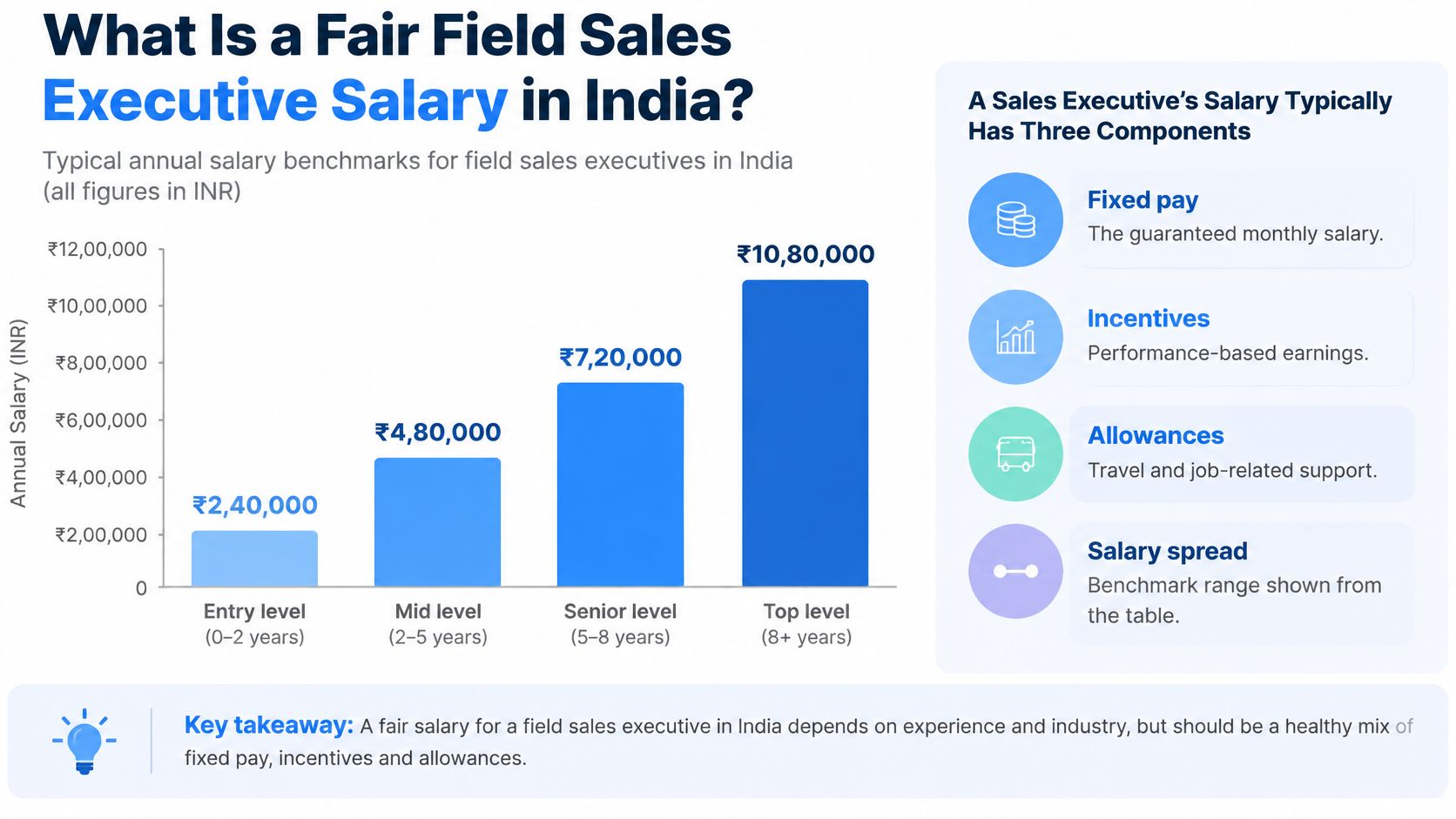
A field sales candidate in Indore and one in South Mumbai can hold the same title and live in completely different pay realities. City tier, industry margin, seniority, and the split between fixed pay and variable commission all move the number, which is why one blurry CTC figure in a job post creates immediate mistrust during offer negotiation.
The chart below illustrates how pay structures should separate fixed salary, variable incentives, and field allowances alongside experience-based annual benchmarks.
Published Pay Benchmarks in India
Current market datasets show why employers can't rely on a single national average. Based on data from more than 1.7 lakh employees, AmbitionBox reports an annual sales executive salary range of ₹1.2 lakh to ₹5.4 lakh, averaging ₹3.1 lakh per year (around ₹26,100 per month), climbing from ₹2.6 lakh for under three years of experience to ₹4.9 lakh at 10 to 20 years.
At the active hiring end of the market, BetterJobs tracked 28,748 active field-sales-executive listings from 7,205 employers in 2026 with a median advertised pay of ₹20,000 per month, giving a sharp live signal for entry and junior frontline roles.
Read those two sources together and the hiring picture becomes clear. Most live postings target the junior end of the market, while the averages include experienced executives who have spent years building territory relationships. If your role demands a candidate who already knows the distributor network in their district, expect to pay toward the upper half of the range rather than the median advertised figure.
| Source | Measure | Value |
|---|---|---|
| AmbitionBox (over 1.7 lakh employees) | Annual salary range | ₹1.2 lakh to ₹5.4 lakh |
| AmbitionBox | Average annual pay | ₹3.1 lakh (about ₹26,100 per month) |
| AmbitionBox | Average pay, under 3 years experience | ₹2.6 lakh |
| AmbitionBox | Average pay, 4 to 9 years experience | ₹3.4 lakh |
| AmbitionBox | Average pay, 10 to 20 years experience | ₹4.9 lakh |
| BetterJobs (2026) | Median advertised pay, field sales executive listings | ₹20,000 per month |
Structuring Pay Transparently in Your Posting
Break every offer and job post into three separate INR lines: fixed monthly salary, variable incentive formula tied to named targets, and field allowances covering two-wheeler fuel reimbursement, local conveyance, and mobile or data support. A rider covering 60 kilometres a day cares about fuel reimbursement as much as base pay, and hiding it inside one CTC number tells them you don't understand the job.
The incentive line deserves the most care. Name the target it ties to, whether order value, productive outlet count, or collections, and state how often it pays out. Vague promises of "attractive incentives" attract candidates who negotiate hard at offer stage and leave within a quarter when the first payout disappoints them.
If internal bands aren't finalised for a new territory yet, say so directly: pay is calibrated to product experience and territory tier, not to a published range inflated beyond what the finance team will approve. I would rather lose a few applicants at the posting stage than spend interview hours on candidates who withdraw once they hear the actual figure. Transparent pay disclosure screens for people who can genuinely afford the role, and those are the hires who stay beyond their first incentive cycle.
How to Screen Hundreds of Field Sales Applicants a Week
High-volume field drives across twenty districts break manual recruiting fast. Recruiters lose days dialling unreachable numbers, switching between regional languages, and reading unformatted CVs while strong local candidates accept competing offers elsewhere. A vague process wastes the exact candidate pool you need: people who know the territory, speak the language, can manage field days, and will accept the pay structure after seeing it plainly.
The infographic below maps out a five-stage funnel built to keep frontline screening fast without dropping quality standards.
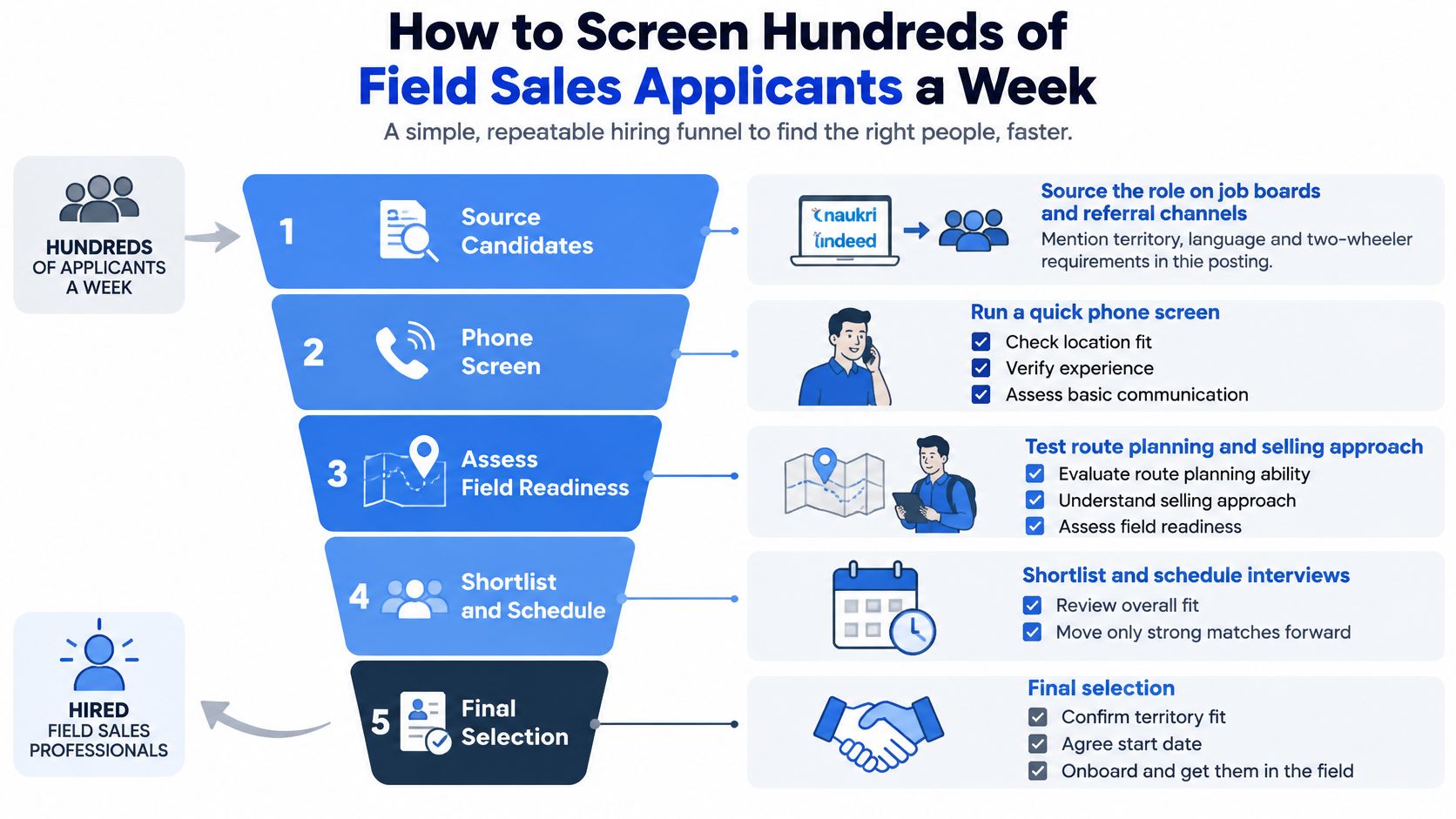
Five Stages of a High-Volume Field Funnel
- Targeted sourcing with explicit filters: Post the role across job boards, employee referral drives, and active sourcing channels with headquarters town, territory language, two-wheeler expectations, and pay structure stated in the summary. For AI sourcing, brief the screening platform with a job description, a few bullet points, or an existing profile. It builds search criteria from that input, runs active candidate sourcing, and returns candidates who match on experience, skills, and compensation range.
- Rapid CV screening on three anchors: Screen resumes strictly for comparable product category experience, local territory ties, and verifiable sales numbers. Ignore formatting polish and college names unless the role really depends on them. The practical filter is simple: has this person sold a comparable product, in a comparable market, with numbers that can be checked?
- Multilingual voice screening at scale: Run structured first-round phone screens in the language the candidate sells in. Automated voice screening can ask about field readiness, territory, two-wheeler availability, notice period, and pay expectations, then deliver a structured scorecard by morning. Candidates answer role-specific questions in conversation, and the team receives a structured scorecard for review before interviews move forward.
- Structured recruiter and manager interviews: Recruiters interview only the top-scoring band using the twelve-question guide and weighted rubric. Judgment matters most at this stage. Managers test territory thinking, customer handling, and whether the candidate understands the travel load. Verification workflows help teams with spotting red flags in reports before extending an offer.
- WhatsApp scheduling and follow-up: Confirm interview slots, send location pins, and share document checklists on WhatsApp so candidates do not miss reminders buried in email inboxes. WhatsApp also works well for quick changes, because field candidates often respond faster between meetings and route plans.
The screening platform plugs into the customer's ATS, sourcing channels, and calendars, then hands off shortlists with structured insights to recruiters and hiring managers. Recruiters keep full ownership of human judgment and final selection while repetitive first-round calls and scheduling follow-ups move out of the critical path. That division matters in multi-city hiring: speed improves when the team reviews comparable evidence instead of rebuilding the same facts in every call.
To see how automated multilingual voice screening fits into a live frontline workflow, watch the walkthrough below.
For enterprise TA leaders running multi-city recruitment drives, this playbook on high-volume hiring in India with AI breaks down throughput benchmarks and recruiter workflows in more detail.
Staying Compliant Under India's DPDP Framework
High-volume field hiring moves sensitive personal data fast: phone numbers, driving licences, Aadhaar or identity records, salary slips, and background checks often pass through agencies, spreadsheets, and WhatsApp chats. According to LexOrbis's analysis of the DPDP Act 2023 and DPDP Rules 2025, employment-related processing can fall under a permitted employment purpose without separate consent, yet employers still hold strict duties around transparency, security safeguards, access control, retention limits, and breach response.
Whenever candidate data is used for any purpose outside direct hiring, consent must be free, specific, informed, unconditional, and unambiguous, backed by clear notice. Limit collection to what the role requires, set vendor and recruiter permissions inside enterprise systems built for GDPR and DPDP compliance, and enforce documented deletion schedules for unselected applicants. Multi-factor authentication and single sign-on are available for enterprise customers, which helps when several recruiters and managers touch the same candidate records.
Why Field Offers Drop Off and How to Stop It
A field offer falls apart when the job looks simple on the call and difficult on the ground. Candidates discover the daily travel load on day three, realise the advertised monthly incentive depends on targets they cannot reach, learn that fuel comes out of pocket, or get stuck in a notice-period dispute nobody resolved early.
Target realism is a major friction point across India's sales workforce. In UpGrad Enterprise's 2024 survey of 3,911 sales professionals published in The Grand Sales Workplace Report, 79% of Indian sales professionals reported struggling with unrealistic targets. When expectations shift after acceptance, candidates start treating the offer as risky rather than exciting. The manager then spends weeks renegotiating, replacing a dropout, or restarting the same role in another city.
Six Pre-Offer Confirmations That Protect Joining Ratios
Lock down these six checks before any formal offer letter goes out:
- Verify notice period and joining date on call one: Confirm whether a buyout is needed, who pays for it, and the date they can realistically join before investing manager time.
- Put territory and field days in writing: Share the exact headquarters town, pin-code coverage, and weekly travel split in an email or WhatsApp summary prior to the final round.
- Itemise pay with a worked incentive example: Present fixed monthly pay, two-wheeler and phone allowances, and a plain INR example showing what an executive earns in an average month versus a strong month.
- Check vehicle and licence readiness early: Confirm the candidate holds a valid licence and owns or can reliably arrange a two-wheeler before final selection.
- Preview the first week on the job: Outline the opening beat route, field reporting app, buddy ride-alongs, and the timing of the first target review so day one feels organised.
- Compress the verbal-to-written offer gap: Issue written offer letters promptly and reconfirm candidate intent after every round rather than going silent for a week.
A structured AI call can ask role-specific questions in conversation and deliver a scorecard to your team by morning, which helps recruiters spot mismatch before the final round. Keep the offer conversation with the recruiter. That boundary matters because candidates will accept tough field conditions when the facts arrive early, in plain language, with a human ready to answer the awkward questions.
Field Sales Executive Hiring Questions Answered
Is a field sales executive the same as a telecaller?
A field sales executive sells through territory visits, while a telecaller works mainly from a desk. The useful distinction is where revenue conversations happen. If the role includes both beat visits and phone follow-ups, write the split plainly.
How much travel should a field sales job description state?
Use wording candidates can picture: "Two-wheeler travel acrossassigned pin-code clusters, with headquarters in [town] and weekly field days in [area]." That says more than "travel required" and filters out people who cannot meet the transport reality.
Should the job description require a college degree?
Keep degree filters narrow. If the role does not need a specific qualification for regulatory reasons, screen on route knowledge, category experience, local language fluency, and evidence of hitting targets. That brings in stronger field sellers who may not have the credential but know the market.
Should employers publish the salary range in the job posting?
Yes, whenever internal bands are approved. List fixed monthly pay, variable incentive structure, and two-wheeler or phone allowances separately in INR; if bands vary by town class, state that openly and explain how pay is calibrated so strong candidates don't walk away guessing.
How long should companies keep field sales applicant data?
Define a documented retention window aligned with India's DPDP framework and delete or anonymise records for unselected applicants once that period ends. Keep candidate documents inside access-controlled recruiting systems rather than personal spreadsheets or unmanaged chat threads.
Talent acquisition teams wanting to test this structured screening workflow on an active territory role can book a personalised demo of the Dassh AI suite, request a security walkthrough, or talk to sales directly.